From Reactive to Predictive: How Informatica and Agentforce Turn Historical Data into Forward-Looking Strategy
- Ohana Focus Team

- May 28
- 10 min read

Most organizations are sitting on years of valuable data—giving histories, client engagement records, service logs, transaction patterns—yet they use almost none of it to anticipate what comes next. Instead, they use it to explain what has already happened.
That's the definition of reactive data management: running reports after the fact, discovering donor attrition after it spikes, flagging a compliance gap after an audit flags it, or realizing a top client is disengaging after they've already started the process of leaving. The data was there all along. It just wasn't working hard enough.
The combination of Informatica IDMC and Salesforce Agentforce changes that equation. Informatica ensures the data flowing into your systems is clean, unified, and trustworthy. Agentforce acts on that data intelligently—surfacing early warnings, automating follow-up, and enabling organizations to get ahead of problems instead of reacting to them. For nonprofits, wealth management firms, financial services companies, and service-based businesses alike, this shift from reactive to predictive isn't a technology upgrade—it's a strategic transformation.
Why Reactive Data Management Falls Short
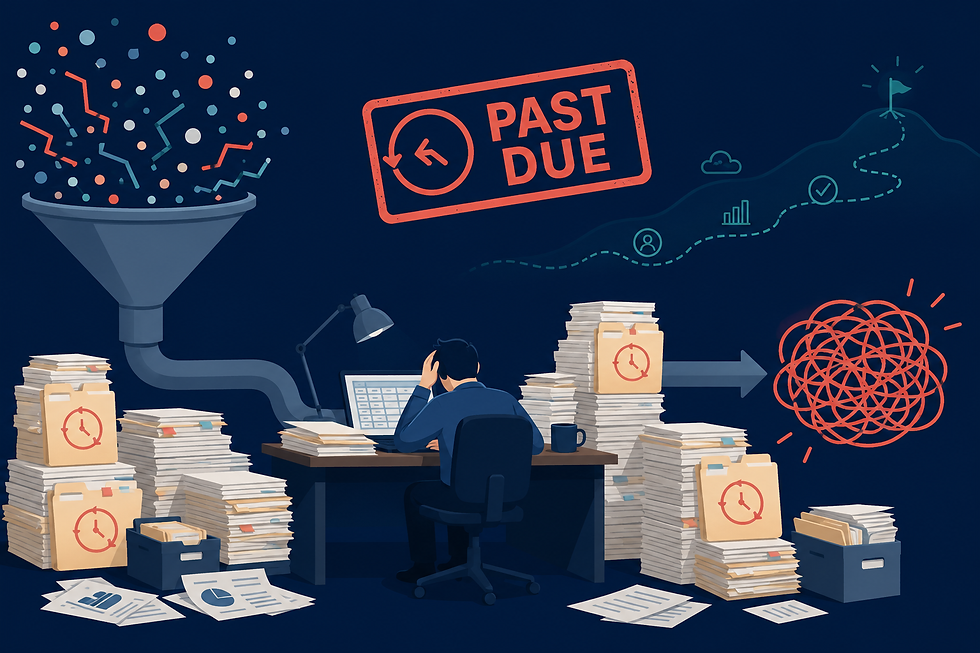
The reactive cycle is familiar across industries. A nonprofit development team notices donor retention has dropped—but only when pulling the year-end report in December. A financial advisor realizes a high-value client relationship has gone quiet—but only after the client begins moving assets. A construction company discovers that three equipment failures occurred in the same quarter, only after reviewing maintenance logs at year-end.
In each case, the problem didn't emerge overnight. The warning signs were embedded in the data for weeks or months. The challenge wasn't a lack of information—it was a lack of infrastructure to surface the right signals at the right time. Reactive data management has two root causes that Informatica and Agentforce directly address:
Data Quality Problems
When records are duplicated, incomplete, or inconsistently formatted, reports become unreliable. The staff stops trusting the data and analyses require manual cleanup before they can be used. By the time a clean picture emerges, the window for proactive action has closed.
No Intelligence Layer
Clean data alone doesn't predict anything. Without an AI layer capable of recognizing patterns, scoring risk, and triggering automated responses, even high-quality data just sits in reports waiting to be read—usually too late. Informatica solves the first problem. Agentforce solves the second. Together, they create the infrastructure for a genuinely predictive strategy.
Informatica IDMC: The Foundation Predictive Strategy Requires

Predictive AI is only as reliable as the data it runs on. Feed Agentforce incomplete donor records, duplicate client contacts, or inconsistently formatted transaction histories, and its predictions will reflect those flaws. Garbage in, garbage out—at AI speed.
Informatica Intelligent Data Management Cloud (IDMC) is the platform that ensures the data foundation is sound before intelligence is layered on top. It handles the upstream work that makes downstream AI trustworthy.
Data Profiling and Quality Scoring
Before meaningful predictions can be made, organizations need to understand what their data actually looks like. Informatica's data profiling tools scan existing records and surface issues: incomplete fields, formatting inconsistencies, duplicate entries, and relationship gaps. Rather than discovering these problems in the middle of a critical report, teams can identify and resolve them systematically.
Imagine a hypothetical regional food bank that has operated for 15 years on a legacy donor database. Before migrating to Salesforce, an Informatica data profile reveals that 23% of donor records have duplicate entries, 41% are missing a phone number or email, and gift history for recurring donors is split across three separate tables. That profile becomes the roadmap for cleanup—and the guarantee that the CRM migration starts with trustworthy data rather than compounding existing errors.
Master Data Management
For organizations managing relationships across multiple systems—a CRM, a financial platform, a grant management tool, a field service application—the same person or entity often appears differently in each system. Informatica's master data management capabilities create a single, authoritative record that other systems reference, eliminating the fragmentation that makes cross-system analytics unreliable.
Real-Time Data Integration
Predictive strategy requires current data, not nightly batch updates. Informatica's integration pipelines can move and transform data in real time across connected systems, ensuring that when Agentforce evaluates a donor's engagement score or a client's portfolio risk, it's working from information that's minutes old—not days old.
Agentforce: Turning Clean Data into Forward-Looking Action

With Informatica providing a reliable data foundation, Agentforce takes on the intelligence layer. It doesn't just surface reports—it interprets patterns, scores risk, and triggers automated workflows based on what the data predicts, not just what it records.
Predictive Scoring and Early Warning
Agentforce can be configured to run continuous scoring models against your Salesforce data. For a nonprofit, that might mean a donor engagement score that weighs recency, frequency, giving amount, event participation, and email engagement into a single number.
When a donor's score drops below a defined threshold, Agentforce doesn't wait for a report to flag it—it automatically creates a task for the relationship manager, drafts a personalized outreach message, and logs the interaction for tracking.
For a wealth management firm, a similar model might score client relationship health based on last contact date, portfolio performance relative to benchmarks, recent account activity, and service ticket history. A client who scores below threshold triggers an automated priority follow-up queue—before they call a competitor.
Agentic Workflow Automation
Beyond scoring, Agentforce can execute multi-step workflows autonomously once a trigger condition is met. A hypothetical example: a construction and logistics firm tracks equipment maintenance records in Salesforce Field Service. When Agentforce detects that a specific piece of equipment has logged three service requests within 30 days, it automatically creates a preventive maintenance work order, notifies the dispatch team, and updates the asset record with a recommended inspection date—without a human reviewing a weekly report first. This is what makes Agentforce genuinely agentic: it doesn't just alert people to patterns; it initiates appropriate responses within defined guardrails.
Natural Language Analytics
One of the most immediate productivity gains comes from Agentforce's ability to answer data questions in plain language. Instead of waiting for a database administrator to run a query, an executive director can ask: 'Which major donors haven't given this fiscal year but gave in each of the past three years?' and receive a formatted answer with an option to act on it immediately. This capability lowers the barrier to data-informed decisions at every level of an organization—from frontline staff to board members—without requiring everyone to learn SQL or navigate complex report builders.
What This Looks Like Across Industries

Nonprofits: Donor Retention and Program Outcomes
Consider a hypothetical human services nonprofit with 8,000 active donors. Historically, their development team pulled a monthly LYBUNT (Last Year But Unfortunately Not This Year) report, then spent two weeks manually segmenting and reaching out to lapsed donors. By the time outreach happened, many donors had already redirected their giving.
With Informatica cleaning and unifying their data across their CRM, email platform, and event system, and Agentforce running a continuous engagement model, the picture changes. Donors showing early attrition signals—such as declining email open rates, skipping annual event registration, or reduced giving frequency—are flagged in real time. Agentforce creates personalized outreach sequences automatically, assigns high-value lapsed donors to specific gift officers, and tracks response rates without requiring manual coordination.
The result: a shift from a once-monthly reactive report to a continuous, proactive retention system.
Wealth Management: Client Relationship Health

A hypothetical independent wealth management firm managing 300 client households faces a common challenge: relationship managers carry large books of business, and clients who don't proactively reach out can drift quietly toward disengagement. By the time a client mentions they're considering other firms, the relationship is already at risk.
With Agentforce running relationship health scoring across unified client data—pulled from Salesforce Financial Services Cloud and enriched through Informatica's integration layer—relationship managers receive a daily prioritized list of clients who warrant proactive contact. The system doesn't just flag who is at risk; it recommends the appropriate touchpoint (a quarterly review call, a market update email, a portfolio adjustment conversation) based on the client's engagement history and current portfolio context.
Financial Services: Compliance and Risk Signals
Compliance officers at financial services firms often operate in a reactive mode by necessity—regulations are documented after they're enacted, and audits surface issues after transactions occur. But many compliance risks have data signatures that precede actual violations.
A hypothetical regional credit union, for example, might configure Agentforce to monitor transaction patterns against defined risk thresholds. When an account's activity deviates from its historical baseline in ways that align with known fraud patterns, an automated alert routes to the compliance team before the transaction clears—not in the next audit cycle.
Informatica's role here is critical: ensuring that transaction records from the core banking system, the CRM, and the member portal are unified and consistently formatted before Agentforce attempts to interpret them. Pattern recognition requires pattern consistency.
Service-Based Businesses: Field Operations and Predictive Maintenance
For construction companies, logistics providers, and field service organizations, data often lives in disconnected silos—dispatch systems, asset management tools, accounting platforms, and CRM are rarely talking to each other in real time. The result is reactive operations: equipment fails, routes are inefficient, service calls pile up, and managers spend time consolidating reports rather than improving operations.

A hypothetical mid-sized logistics company integrating its fleet management system, dispatch platform, and Salesforce through Informatica creates a unified data environment where Agentforce can identify patterns across historical delivery records, vehicle maintenance logs, and client SLAs. The system flags which routes are consistently underperforming, which vehicles are trending toward failure, and which client accounts are at risk of SLA breach—before any of those outcomes occur.
Reactive vs. Predictive: A Direct Comparison

The operational difference between reactive and predictive data management is significant across every function:
Capability | Reactive Approach | Informatica + Agentforce |
Data Quality | Errors caught after impact | Validated before processing |
Reporting Cycle | Monthly snapshots | Real-time, continuous signals |
Forecasting | Intuition + spreadsheets | Pattern-driven AI predictions |
Staff Time | Manual queries & cleanup | Automated, exception-based alerts |
Decision Speed | Days to weeks | Hours to real-time |
Risk Detection | Post-event review | Early-warning triggers |
The goal isn't to replace human judgment—it's to make human judgment more timely and more informed.
A Look at Complexity and Investment

We believe in being direct with the organizations we work with: implementing Informatica and Agentforce together is not a plug-and-play project. It requires thoughtful planning, realistic timelines, and organizational commitment.
Data Readiness Takes Time
For most organizations, the Informatica implementation phase is the most intensive work. Profiling, deduplicating, and migrating legacy data requires both technical skill and institutional knowledge. It's not unusual for a thorough data quality initiative to take three to six months before the Salesforce environment is ready to support reliable AI-driven workflows.
That investment is worth it—but it should be scoped honestly at the outset, not discovered midway through implementation.
AI Models Require Configuration and Iteration
Agentforce's predictive capabilities don't arrive pre-calibrated for your organization. Engagement scoring thresholds, workflow trigger logic, and automated response templates all need to be configured based on your operational realities and refined over time as you observe how the system performs. Teams should expect a period of calibration—typically 60 to 90 days post-launch—before confidence in the system's outputs is high.
Change Management is Non-Negotiable
The most common failure mode we see in AI implementations isn't technical—it's adoption. Staff who don't trust automated recommendations will ignore them. Leadership that doesn't reinforce data-informed decision-making will undermine the investment. Successful implementations pair technical configuration with structured training, clear communication about what the system does and doesn't do, and executive sponsorship that models the behaviors being asked of everyone else.
The Right Expectations
Organizations that approach Informatica and Agentforce with realistic timelines, investment in data quality upfront, and a genuine commitment to changing how decisions get made consistently see strong ROI—not because the technology is magic, but because clean data plus intelligent automation genuinely changes what's possible. Those who treat it as a quick-win technology deployment typically see middling results and frustrated staff.
Moving from Reactive to Predictive: Practical First Steps

For organizations ready to begin this journey, the path forward is more straightforward than it might appear from the outside.
Audit Your Current Data State
Before any technology decisions are made, understand what you're working with. How many duplicate records exist in your CRM? What percentage of key fields are populated? How many source systems are you trying to connect? A data audit doesn't require Informatica—it can be done with your existing tools—but it produces the roadmap that determines your Informatica implementation scope.
Define the Three Decisions You Most Need to Make Faster
Predictive strategy is most powerful when it's tied to specific, high-value decisions. Rather than trying to predict everything, identify the three decisions that, if made two weeks earlier, would create the most organizational value. For a nonprofit, that might be identifying at-risk major donors. For a wealth management firm, it might be catching client disengagement. For a construction company, it might be preventing equipment failure mid-project.
Those three use cases become your implementation priorities—the places where Informatica data quality and Agentforce intelligence will be configured first, where the ROI will be most visible, and where early wins will build organizational confidence.
Build the Data Layer Before the AI Layer

The sequence matters. Organizations that try to implement Agentforce on top of poor-quality, fragmented data will get unreliable results, which damages confidence in the technology before it's had a fair chance. Informatica's data quality and integration work should precede, or at a minimum run concurrently with, Agentforce configuration. Don't skip the foundation.
Start Small, Prove Value, Expand
Pilot your predictive use case with one team or one function before rolling out organization-wide. Run the traditional reactive process in parallel for the first 60 days. Compare outcomes. When the predictive system catches something the old system missed—and it will—that's the moment organizational confidence shifts. That single proof point does more for adoption than any training session.
Partner with Ohana Focus

Ready to move beyond reactive reporting? Make the shift from reactive to predictive with expert guidance. Schedule your free consultation today.
Ohana Focus is a certified Salesforce consulting partner with deep experience in Informatica IDMC and Agentforce implementations for nonprofits, wealth management firms, financial services companies, and service-based businesses. We don't just configure software—we help organizations build the data foundations and AI workflows that support genuinely forward-looking strategy.
We bring:
Informatica IDMC implementation, data profiling, and migration expertise
Agentforce configuration for predictive scoring, automated workflows, and natural language analytics
Cross-industry experience across nonprofits, financial services, and field service operations
Change management and staff training to ensure adoption, not just deployment
Ongoing support and model refinement as your organization's needs evolve
About Ohana Focus
Ohana Focus is a certified Salesforce consulting partner dedicated to helping organizations across sectors harness the full power of their data. We specialize in Salesforce implementation, Agentforce AI automation, and Informatica IDMC data governance—bringing a compliance-aware, practical approach to every engagement.
Our team has guided nonprofits, wealth management firms, financial services organizations, and service-based businesses through the full journey from legacy systems to intelligent, AI-powered operations. We believe great technology implementations start with honest conversations, rigorous data foundations, and a genuine commitment to the people who will use the systems every day.


Comments