Building Guardrails for AI in Regulated Industries
- Ohana Focus Team

- Apr 22
- 9 min read

Imagine this: A wealth management firm deploys an AI agent to handle routine client inquiries. It handles account balance questions, appointment scheduling, and market summary requests—all flawlessly. Then one afternoon, a client asks the agent whether they should move their retirement portfolio into a different fund given recent market volatility. The agent, drawing on its training data and CRM context, offers a confident-sounding recommendation. It cites performance figures. It sounds exactly like the kind of guidance a seasoned advisor would give. No human reviewed it. No compliance officer flagged it. And the recommendation, while plausible-sounding, wasn't suitable for that client's specific risk profile or investment objectives.
This scenario—and countless variations like it—is why the conversation about AI agents in regulated industries can't stop at efficiency gains. Before any organization in wealth management, financial services, nonprofit fundraising, or regulated service industries like healthcare-adjacent construction or logistics goes live with Salesforce Agentforce, they need a frank, practical answer to a deceptively simple question: what happens when the agent gets it wrong?
The good news is that Salesforce has built meaningful safeguards into the Agentforce architecture. The better news is that organizations willing to invest in proper implementation—with the right partner—can deploy agents that genuinely accelerate productivity while keeping risk firmly under control. We'll walk through both sides of that equation here.
The Real Risks of AI Agents in Regulated Environments
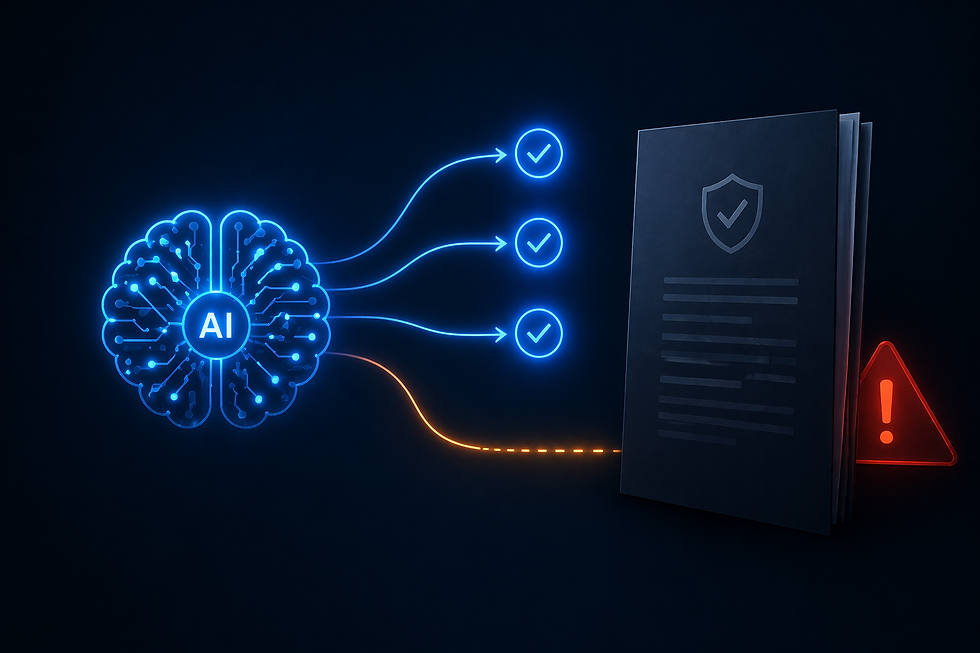
Before exploring the guardrails, it's worth being honest about what can actually go wrong. AI agents don't fail dramatically. They don't crash systems or lock users out of databases. They fail quietly—with confident-sounding, plausible-seeming outputs that happen to be wrong, incomplete, or inappropriate for a specific context.
Hallucination and Confident Errors
Large language models—the technology underpinning Agentforce agents—can generate factually incorrect information while presenting it with the same confident tone as accurate information. In a low-stakes context, this might mean a slightly wrong summary of a meeting. In a regulated context, it could mean incorrect information about a client's account status, a misquoted compliance deadline, or a faulty interpretation of a policy document.
Scope Creep and Unauthorized Actions
Agents configured to take actions—sending emails, updating records, triggering workflows—can occasionally execute those actions in unintended ways. An agent built to draft acknowledgment letters for a nonprofit might, if poorly scoped, modify donor records it was never meant to touch. An agent managing logistics dispatch orders might push through a change without the human review that regulations require.
Regulatory and Fiduciary Exposure
In financial services and wealth management, the stakes are particularly high. FINRA regulations, fiduciary duty standards, and SEC guidance all impose specific requirements around investment advice, client communication, and record-keeping. An agent that crosses the line between providing information and offering advice—even unintentionally—can create material compliance exposure. The same logic applies to healthcare-adjacent organizations, legal services, and any sector where professional licensing governs what can be said to clients and when.
Why This Matters for Nonprofits
It's easy to assume that regulated-industry guardrail concerns don't apply to nonprofits. But consider: a nonprofit serving vulnerable populations may handle sensitive case data. A donor-advised fund program requires careful language around tax implications. Grant reporting involves financial representations. The failure modes are different from a bank, but the need for careful agent scoping is just as real.
How Agentforce Addresses Risk by Design
Salesforce built Agentforce with a layered architecture specifically designed to make agents both powerful and controllable. Understanding how this works helps IT decision-makers and executives have informed conversations with implementation partners—and ask the right questions before going live.
The Einstein Trust Layer

At the foundation of Agentforce's safety architecture is the Einstein Trust Layer—a set of security and governance controls that sit between agent activity and Salesforce data. The Trust Layer handles several critical functions that directly reduce risk in regulated deployments.
First, it enforces data masking and access controls. When an agent retrieves data to answer a question or take an action, it only sees the data that the underlying user's permission set allows. This means an agent helping a junior advisor can be architecturally prevented from accessing data that only senior advisors or compliance officers are allowed to see—even if someone asks it a question that would require that data to answer.
Second, the Trust Layer includes zero-data-retention agreements with the large language models powering agents. When your organization's data is sent to an AI model for reasoning and response generation, it isn't stored or used for model training by the provider. For organizations operating under GDPR, CCPA, HIPAA-adjacent standards, or internal data governance policies, this matters enormously.
Third, every agent interaction is logged. The full prompt, the data retrieved, the reasoning chain, and the output are captured in an audit trail. For financial services organizations subject to FINRA record-keeping requirements or nonprofits subject to grant audit requirements, this provides the documentation backbone that compliance demands.
Topic Scoping and Action Guardrails
Agentforce agents aren't general-purpose AI systems. They're configured entities with explicit definitions of what topics they are allowed to address, what data they can access, and what actions they can take. This scoping isn't advisory—it's enforced at the platform level.
Think of it this way: a Wealth Management Client Service Agent can be configured to answer questions about account statements, schedule meetings, provide general market information, and escalate complex queries to a human advisor. It can be explicitly configured to never provide investment recommendations, never execute trades, and always route regulatory questions to compliance staff. These aren't just prompting instructions—they're architectural boundaries that the agent cannot cross, regardless of how a question is phrased.
Human-in-the-Loop Escalation

One of the most practically important guardrails in Agentforce is configurable escalation logic. Organizations can define the specific conditions under which an agent must stop, acknowledge that the question exceeds its scope, and route the interaction to a human, with full context passed along.
In a hypothetical construction logistics company, an agent might be configured to handle route optimization inquiries and delivery status questions autonomously. But any inquiry touching a regulatory filing, a customer dispute above a certain dollar threshold, or a safety compliance matter would immediately escalate to a human dispatcher or compliance officer. The agent doesn't try to answer those questions. It hands off—cleanly, transparently, and with documentation.
Industry-Specific Guardrail Strategies

General guardrail principles are valuable, but implementation looks different across industries. Here's how thoughtful Agentforce deployments address the specific risk profiles of four key sectors.
Wealth Management and Financial Services

Hypothetical Scenario A regional wealth management firm deploys an Agentforce agent to handle inbound client service inquiries. The agent is scoped to: Allowed: Account balance inquiries, statement requests, appointment scheduling, and general market information from approved data sources. Escalated: Any question containing language related to investment recommendations, tax advice, regulatory filings, or account changes above a defined dollar threshold. Logged: Every interaction, with compliance review dashboards built directly in Salesforce. Result: The agent handles roughly 60% of inbound volume without human involvement, freeing advisors to focus on relationship management and complex planning conversations. |
The critical implementation discipline in financial services is the distinction between information and advice. Agents should be trained—through both system prompting and topic scoping—to recognize the boundary and never cross it. When in doubt, escalate. The efficiency loss from an unnecessary escalation is trivial. The compliance exposure from an unauthorized recommendation is not.
Nonprofit Organizations
Nonprofits often underestimate their regulatory exposure. But organizations managing restricted grant funds, handling donor tax documentation, or operating in healthcare or social services face real compliance requirements that AI agents must respect.
Hypothetical Scenario A community foundation deploys an agent to handle donor inquiries and gift processing support. Guardrails include: Allowed: Giving history lookups, acknowledgment letter status, fund information, event registration. Escalated: Any question about tax deductibility specifics, donor advised fund distributions, or grant compliance. Restricted: The agent cannot make any representation about the tax treatment of a gift without routing to a human staff member who can review the donor's specific situation. Result: Donor service response times dropped significantly, while the organization maintained clean audit trails for every donor interaction involving financial representations. |
For nonprofits, the equally important guardrail concern is data sensitivity. Organizations serving vulnerable populations—domestic violence survivors, youth in foster care, individuals in recovery—must ensure that AI agents cannot inadvertently expose case data, even to staff members who shouldn't have access to specific records.
Construction and Logistics
In regulated service industries, the failure modes shift from advice risk toward operational and safety risk. An agent that misroutes a hazardous materials shipment, misinterprets a compliance deadline for a building permit, or incorrectly updates a safety inspection record creates liability that can be severe.
Hypothetical Scenario A regional logistics company deploys agents to handle dispatch coordination and customer status inquiries. Their guardrail framework includes: Allowed: Delivery status updates, route inquiries, standard scheduling changes, document retrieval. Human-required: Any change to a shipment tagged as hazardous material, any customer dispute resolution involving credits above $500, any interaction with a regulatory portal. Audit logged: All agent-initiated record changes with before/after state captured. Result: Dispatchers reclaimed hours per week previously spent on routine status calls, while all regulatory-adjacent actions remained firmly in human hands. |
Healthcare-Adjacent Organizations
Organizations operating near healthcare—behavioral health nonprofits, social service agencies, healthcare construction firms—often navigate HIPAA considerations even when they aren't traditional covered entities. AI agents that handle any data touching patient or client health information require careful scoping.
The governing principle: if there is any reasonable possibility that an agent interaction could involve Protected Health Information (PHI), that interaction pathway needs explicit guardrails, dedicated audit logging, and human review protocols before deployment.
Building Your Guardrail Framework: A Practical Starting Point
Understanding the architecture is valuable. But what does actually implementing a guardrail framework look like in practice? We recommend starting with four foundational questions before any Agentforce deployment in a regulated context.
What Can This Agent Never Say?
Define the categories of response that are categorically off-limits—not just discouraged. For financial services, this includes investment recommendations, tax advice, and regulatory interpretations. For nonprofits, it includes specific tax deductibility representations and case-sensitive client information. Document these as hard stops, not soft guidelines.
What Actions Require Human Review?
Not every action an agent can take should be automated end-to-end. Define the threshold—dollar amount, data sensitivity, and regulatory category—at which an agent must pause, document, and queue for human approval before proceeding. This is different from escalation for questions; it's governance for actions.
How Will You Monitor Agent Behavior Over Time?
Guardrails aren't a set-and-forget configuration. Salesforce provides monitoring tools for agent activity, but organizations need to designate someone to review those logs regularly, establish alert thresholds for unusual patterns, and build a process for responding when an agent does something unexpected. The audit trail is only valuable if someone is reading it.
What Does 'Wrong' Look Like for Your Use Case?
Before deployment, walk through the failure scenarios specific to your organization. Not generic AI risk scenarios—your scenarios. What would a confidently wrong answer look like in your donor database? What's the worst-case output from your dispatch agent? What would a compliance officer flag in your advisor support agent? Running these scenarios in a test environment before going live is not optional—it's the work that determines whether your guardrail configuration is actually sufficient.
The Honest Trade-Off
Tighter guardrails mean more escalations. More escalations mean some efficiency gain is left on the table. This is the right trade-off in regulated environments. The goal isn't to automate everything—it's to automate what can be safely automated, while keeping human judgment firmly in place for everything that requires it. The organizations that get this balance right are the ones that expand their Agentforce deployments confidently over time.
What This Means for Implementation

None of this architecture delivers value automatically. Agentforce's safety features are powerful, but they require deliberate configuration. The difference between an agent deployment that enhances productivity safely and one that creates compliance exposure almost always comes down to implementation quality.
This is why implementation partner selection matters as much as platform selection. Your Salesforce partner needs to understand not just how to build agents technically, but how your industry's regulatory environment shapes what those agents should—and absolutely should not—do.
Questions worth asking any implementation partner before beginning an Agentforce project in a regulated environment:
Have you deployed Agentforce in our industry? Generic Salesforce experience isn't the same as regulated-industry agent experience.
Can you walk us through your guardrail configuration methodology? This should be a documented process, not an ad hoc one.
How do you approach compliance review before go-live? A responsible partner will insist on it, not just accommodate it.
What does your monitoring and post-deployment support look like? Guardrail frameworks need ongoing attention as agent behavior and organizational needs evolve.
Can you show us the audit trail and monitoring dashboards you've built for similar clients? Seeing real examples matters.
Partner with Ohana Focus

Deploy Agentforce with confidence—and the guardrails your industry requires.
At Ohana Focus, we specialize in Salesforce implementations for regulated industries. We've helped nonprofits, financial services organizations, and service-based companies build AI agent deployments that are not only efficient—they're defensible. That means configurations your compliance team can stand behind, audit trails your board can trust, and escalation frameworks your clients never need to worry about. We don't just build agents. We build guardrail frameworks that define what your agents will never do—because in regulated environments, that's just as important as what they can. We bring:
Regulated-industry Agentforce implementation expertise
Compliance-aware agent scoping and topic configuration
Audit trail and monitoring dashboard design
Escalation workflow architecture
Ongoing guardrail review and optimization support
Team training on responsible AI use in your operational context
About Ohana Focus
Ohana Focus is a certified Salesforce consulting partner dedicated to helping nonprofits, financial services firms, and service-based organizations implement Salesforce with purpose. We believe that responsible AI adoption isn't just about technology—it's about building systems that earn the trust of your clients, your board, and your regulators. From initial scoping through post-deployment monitoring, we bring the expertise, the methodology, and the honest partnership that complex implementations demand.


Comments