The Informed Giver: How Agentforce Is Reshaping Donor Engagement for Nonprofits
- Ohana Focus Team

- Jun 18
- 7 min read
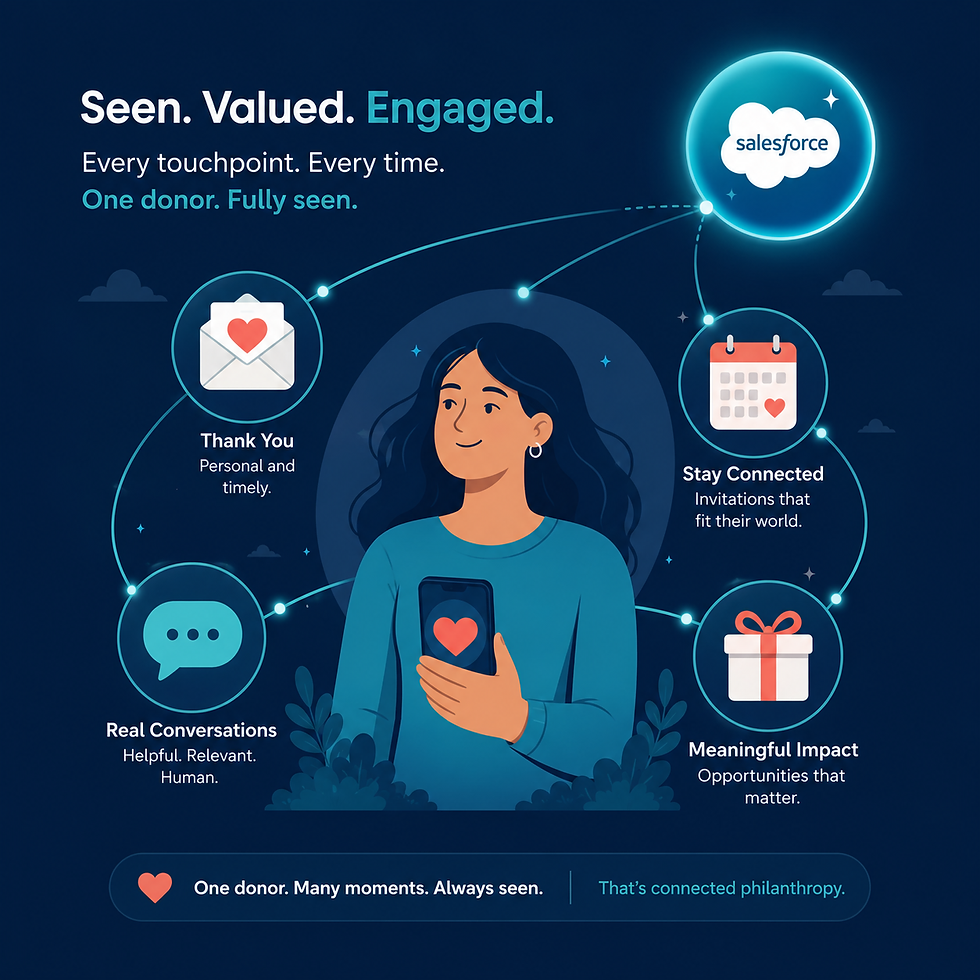
Your donors live in a world of instant, personalized everything. Their bank flags unusual activity within seconds. Their favorite retailer remembers what they browsed last Tuesday. Their streaming service knows what they want to watch before they do. Then they give $250 to your organization—and wait eleven days for a form letter that misspells their name.
That gap is not a staffing problem, and it is not a caring problem. Nonprofit development teams care more about their constituents than almost any commercial enterprise cares about its customers. The gap is a capacity problem: the relationship-building work that donors now expect simply cannot be done by hand at the scale most organizations operate.
This is where Salesforce Agentforce changes the conversation: Not by replacing the human relationships at the heart of fundraising, but by handling the high-volume, time-sensitive donor engagement work that no development team has ever had enough hours to do well. In this post, we will look at what today's donors actually expect, where traditional engagement workflows fall short, what AI agents realistically do about it—and, just as importantly, what they should never be asked to do.
Meet the Informed Giver

Donor expectations have not drifted upward gradually. They have been reset, wholesale, by every other organization donors interact with. The modern donor—what we call the informed giver—arrives at your organization with assumptions formed elsewhere:
They expect acknowledgment to be immediate. Not because they are impatient, but because immediacy is now the baseline signal that a transaction was received and valued.
They expect communication to reflect their history. A donor who has given to your youth programs for six years notices when your appeal letter talks only about the food bank.
They expect to self-serve. Year-end tax receipts, recurring gift changes, event registrations—informed givers would rather handle these at 9 PM on a Sunday than email and wait.
They expect their generosity to be remembered across channels. The donor who volunteered Saturday and gave online Monday is one person, and they expect to be treated as one person.
None of this means donors have become transactional. It means the threshold for feeling genuinely seen has risen. Meeting that threshold manually, for a file of five or ten thousand constituents, is mathematically impossible. Meeting it with AI assistance is now a practical, mid-sized-budget reality.
Where Traditional Donor Engagement Breaks Down

Most development teams are running engagement workflows designed for a smaller, slower era. Three failure points show up almost universally.
The Acknowledgment Lag

Industry research has long suggested that prompt, personal acknowledgment is one of the strongest predictors of a second gift. Yet in practice, gift acknowledgment is a batch process: gifts accumulate, someone runs a mail merge on Friday, and letters go out the following week. The donor's moment of generosity—the emotional peak—passed ten days before your thank-you arrived. The lag is not negligence; it is the natural output of a manual workflow competing with every other manual workflow on the same desk.
The Segmentation Ceiling

Real personalization requires segments small enough to feel individual. Manual segmentation tops out fast: most teams manage four to eight segments per appeal because every additional segment means another version to write, proof, and merge. So lapsed donors get one letter, mid-level donors another, and a 24-year-old monthly digital donor receives roughly the same message as an 80-year-old check-writing annual donor—because there was no time to do better.
The Silent Middle
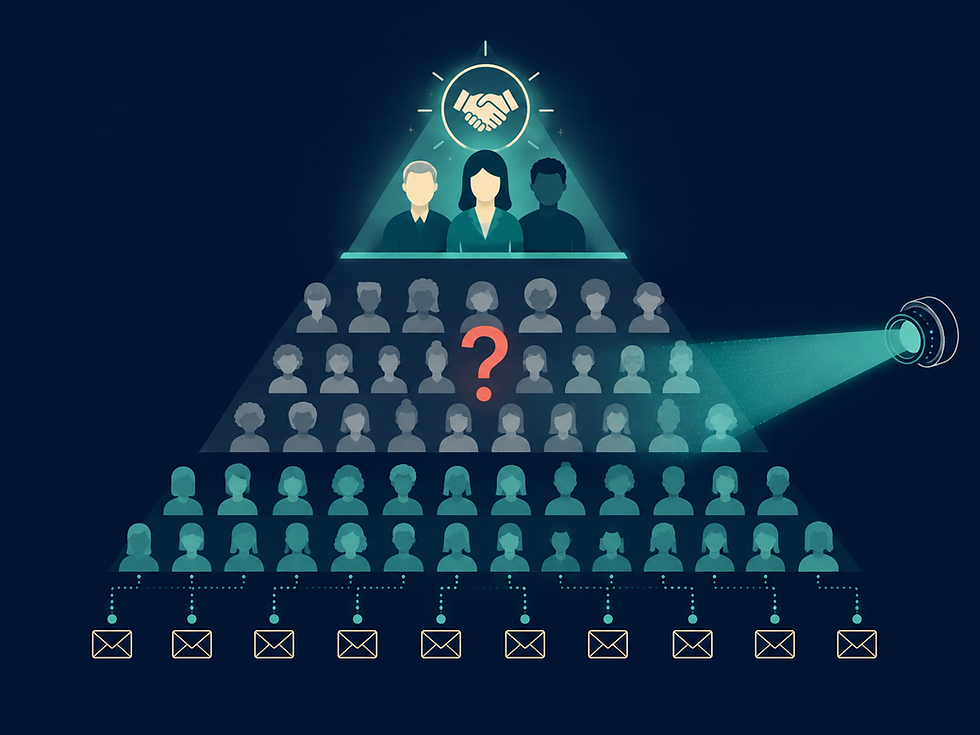
Major gift officers cover the top of the file. Email automation covers the bottom. In between sits the mid-level donor—generous, loyal, and largely uncontacted by an actual human because nobody's portfolio reaches them. This silent middle is where most upgrade potential lives and where most quiet attrition happens. It is also exactly the tier AI-assisted engagement serves best. If your organization can name its top 50 donors but cannot say which 50 mid-level donors are most likely to lapse this quarter, you are not short on data. You are short on the capacity to act on it.
What Agentforce Actually Does for Donor Engagement

Agentforce is Salesforce's framework for AI agents—software that does not just answer questions but takes defined actions inside your CRM (within guardrails your team configures). Unlike a chatbot bolted onto a website, an Agentforce agent works with your live constituent data in Salesforce (including Nonprofit Cloud and NPC environments), which is what makes its engagement work specific rather than generic. Three capabilities matter most for fundraising teams.
Personalized Acknowledgment at Scale

An agent can draft a gift acknowledgment within minutes of the gift posting—one that references the donor's giving history, the program they designated, and the campaign that prompted the gift. Your team reviews and approves; nothing has to go out untouched. The result is acknowledgment that arrives while the giving moment is still warm, with personalization no batch mail merge can match, at a marginal effort of seconds per gift instead of minutes.
Behavioral Signals, Surfaced in Time

Donor files are full of signals nobody has time to watch: the monthly donor whose card failed twice, the annual donor now 60 days past their usual giving date; the event attendee who has never received a follow-up ask; and the mid-level donor whose last three gifts grew by 40% each. An Agentforce agent monitors these patterns continuously and either flags them for staff or initiates a pre-approved outreach sequence. Retention work shifts from quarterly lapsed-donor campaigns—rescuing relationships after they have cooled—to same-week intervention while the relationship is still alive.
Conversational Donor Self-Service
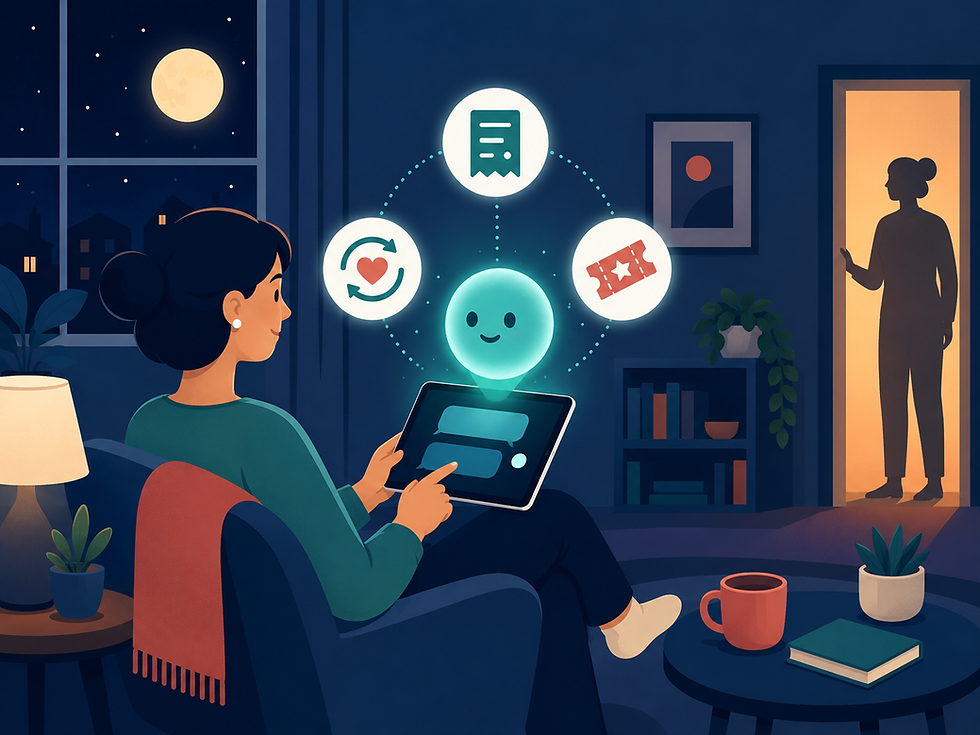
Informed givers want to update a credit card, download a tax receipt, or check their giving history without waiting for office hours. An agent embedded on your website or donor portal can handle these requests conversationally, pulling from and writing to actual Salesforce records—and escalating to a human the moment a conversation calls for one. Staff time once consumed by routine administrative requests returns to relationship work.
A Hypothetical Scenario: Riverbend Community Foundation

Consider a hypothetical mid-sized community foundation—let's call it Riverbend—with 8,500 active donors, a development team of four, and a familiar set of frustrations: acknowledgments averaging nine days, mid-level donors hearing from the foundation twice a year, and a retention rate stuck near 43%.
Riverbend deploys Agentforce in three phases over six months: First, acknowledgment drafting: agents prepare personalized thank-yous for staff approval, cutting average acknowledgment time from nine days to one. Second, signal monitoring: the agent watches for failed recurring payments, giving-anniversary windows, and upgrade patterns, queuing recommended actions each morning for the development associate. Third, a donor self-service agent on the website handles receipts, recurring gift changes, and event questions.
Six months in, the hypothetical results are unremarkable in the best way: acknowledgment within 24 hours as the norm, roughly 30 staff hours per month returned from administrative work, recurring gift failures recovered within days instead of discovered at year-end, and a development team finally having proactive conversations with the silent middle. No single change is dramatic—the compound effect on retention is.
Traditional vs. AI-Assisted Engagement at a Glance

Engagement Task | Traditional Workflow | With Agentforce |
Gift acknowledgment | Batch mail merge; 7–14 day turnaround; generic templates | Drafted within minutes of gift entry; personalized to history; human-approved |
Lapsed-donor outreach | Quarterly list pull after donors have already cooled | Continuous monitoring; outreach triggered within days of risk signals |
Segmentation | 4–8 manual segments per appeal | Dynamic, per-donor personalization within approved templates |
Mid-level donors | Largely untouched between annual appeals | Ongoing, signal-driven touchpoints staff review and send |
Routine requests | Email inbox; answered during office hours | 24/7 self-service agent with human escalation |
Staff time | Majority spent producing communications | Majority spent on relationships and strategy |
Before You Begin

We would be doing you a disservice if we presented AI-assisted donor engagement as friction-free. Four realities deserve clear-eyed attention:
Your data quality sets your ceiling. An agent personalizing from a duplicate-riddled, inconsistently coded donor file will personalize badly—at scale. Most organizations need a data cleanup phase before deployment, and pretending otherwise is how AI projects disappoint.
There is a real cost and configuration investment. Agentforce involves licensing and consumption costs on top of your Salesforce subscription, plus thoughtful configuration of topics, actions, and guardrails. Small organizations with simple files may find well-built automation in Salesforce Flow covers their needs for now—and an honest partner will tell you so.
Human review is not optional in fundraising. Donor communication carries relational and reputational weight. The right pattern for most organizations is agent-drafted, human-approved—especially in the first year. Plan for the review workflow, not just the automation.
Donors deserve transparency. Decide early where you will disclose AI assistance (self-service agents should identify themselves) and what your board's comfort level is. An AI policy adopted before launch is far easier than one written after an awkward question.
What AI Should Never Do in Your Fundraising

Some boundaries are worth stating plainly. AI agents should not make asks for major gifts, conduct condolence or crisis communication, or substitute for the human relationships that define philanthropy. The point of automating the routine 80% of engagement is to give your people back the time to be fully human in the 20% that matters most. Organizations that treat AI as a replacement for building genuine relationships have colder donor files, whereas those that know how to use it to augment established relationships reap the benefits.
Getting Started: A Practical Sequence
If the informed giver is already in your donor file—and they are—here is the sequence we recommend:

Audit your data first. Assess duplicates, missing emails, inconsistent campaign coding, and gift-entry lag. Fix what would embarrass you if an agent repeated it at scale.
Pick one workflow, not five. Acknowledgment drafting is the most common first win: high volume, low risk, immediately measurable.
Configure guardrails before content. Define what the agent may do, what requires approval, and what always escalates to a human.
Measure the donor-visible outcomes. Acknowledgment time, second-gift rate, recurring-gift recovery, and mid-level contact frequency. Hours saved is a means; retention is the goal.
Expand only after trust is earned. When your team stops re-editing the agent's drafts, you are ready for the next workflow.
Partner with Ohana Focus
Bring your donor engagement into the era of the informed giver—without losing the human touch that makes your mission worth giving to. Schedule your free consultation today.
About Ohana Focus
Ohana Focus is a certified Salesforce consulting partner with deep experience helping nonprofits implement Salesforce, deploy Agentforce thoughtfully, and build the clean data foundation AI depends on. We design agent workflows around how your development team actually works, configure the guardrails that keep donor communication safe, and train your staff to stay confidently in control. We bring:
Agentforce strategy, configuration, and guardrail design for fundraising teams
Salesforce and Nonprofit Cloud implementation and migration expertise
Donor data audits and cleanup before AI deployment
Staff training and change management for AI-assisted workflows
Ongoing support as your engagement program matures


Comments