“Without Clean Data, There’s Only Hallucination”: How Ohana Helps You Build the Data Foundation Agentforce Demands
- Ohana Focus Team

- Mar 31
- 10 min read

There is a moment that happens at nearly every Agentforce demo. The prospect watches the AI agent autonomously qualify a donor prospect, flag a stalled grant pipeline, or route a complex service request without any human intervention. Eyes widen. Someone leans forward. And then comes the question: “How soon can we have this?”
It is an understandable reaction. Agentforce is Salesforce’s AI-powered autonomous agent platform and represents one of the most significant productivity leaps in enterprise technology in years. For nonprofits managing donor relationships at scale, wealth management firms tracking complex client portfolios, financial services organizations navigating compliance workflows, and service-based companies coordinating logistics across dozens of job sites, the promise is enormous: intelligent agents that act, not just assist.
But here's what the demo doesn't always show: Agentforce is only as smart as the data it draws from. Feed it incomplete records, duplicated contacts, mislabeled fields, or fragmented relationship histories, and the agent does not slow down—it confidently produces wrong answers. In AI, this is called hallucination. In business, it is called a costly mistake. At Ohana Focus, we believe the most important conversation organizations should have before implementing Agentforce is not “What can the AI do?” but “Is our data ready for what AI will do with it?”
What Agentforce Actually Does—and Why Data Quality Is Everything

Agentforce is not a chatbot, nor is it an autocomplete tool. It's an autonomous agent framework that reads your Salesforce data, reasons about it, takes actions, and in more advanced configurations, learns from the outcomes. Agents can qualify leads, draft personalized outreach, update opportunity stages, trigger workflows, and escalate complex cases to humans, all without anyone clicking a button.
For this to work correctly, the agent needs to interpret context accurately. It needs to know that Jane Smith and J. Smith are the same donor. It needs to understand that a contact marked “prospect” in one field but “major donor” in another requires human judgment, not automated outreach. It needs to recognize that a construction company’s service record from three years ago is not the same relationship signal as one from last month.
When the underlying data is messy—which it almost always is before a thoughtful migration or data audit—the agent works confidently and incorrectly. It will send major gift cultivation emails to lapsed donors. It will flag healthy client portfolios as at-risk. It will fail to route urgent service requests because the priority field was never consistently populated. The speed and automation that make Agentforce powerful become liabilities when the data foundation is weak.
The Four Pillars of an Agentforce-Ready Data Foundation
1. Record Integrity: The Duplicate Problem

Duplicate records are the most common and most damaging data problem in Salesforce environments. A nonprofit with 25,000 contacts in Raiser’s Edge that migrates without deduplication may discover it now has 31,000 Salesforce records—and no reliable way to know which version of each donor is “correct.” A wealth management firm that merged two client databases without deduplication may have client advisors working from incomplete portfolio histories.
For an AI agent, a duplicate is not just a data hygiene inconvenience. It is a fundamentally broken input. The agent may send two separate outreach sequences to the same person. It may count one donor as two separate mid-level prospects rather than one major gift candidate. It may generate reports that dramatically overstate pipeline value. Deduplication is not optional before Agentforce—it is a prerequisite.
2. Field Consistency: The Language the Agent Speaks
Agentforce reasons about your data using the fields and values you have defined in Salesforce. If your “Lead Source” field has 14 different values for what is essentially the same thing—“Website,” “web,” “Online Form,” “site inquiry”—the agent cannot reliably segment and act on lead source data. If your “Opportunity Stage” picklist has stages that different team members interpret differently, agent actions triggered by stage changes will be inconsistent at best and harmful at worst.
Field standardization is painstaking work. It requires understanding not just what values exist in the database but what they were intended to mean, how different users have interpreted them over time, and what the correct taxonomy should look like going forward. We have done this across industries—and the patterns are consistent. Every organization has field inconsistency. The question is how much and how strategically it will be resolved before AI amplifies the problem.
3. Relationship Mapping: Context the Agent Needs to Reason
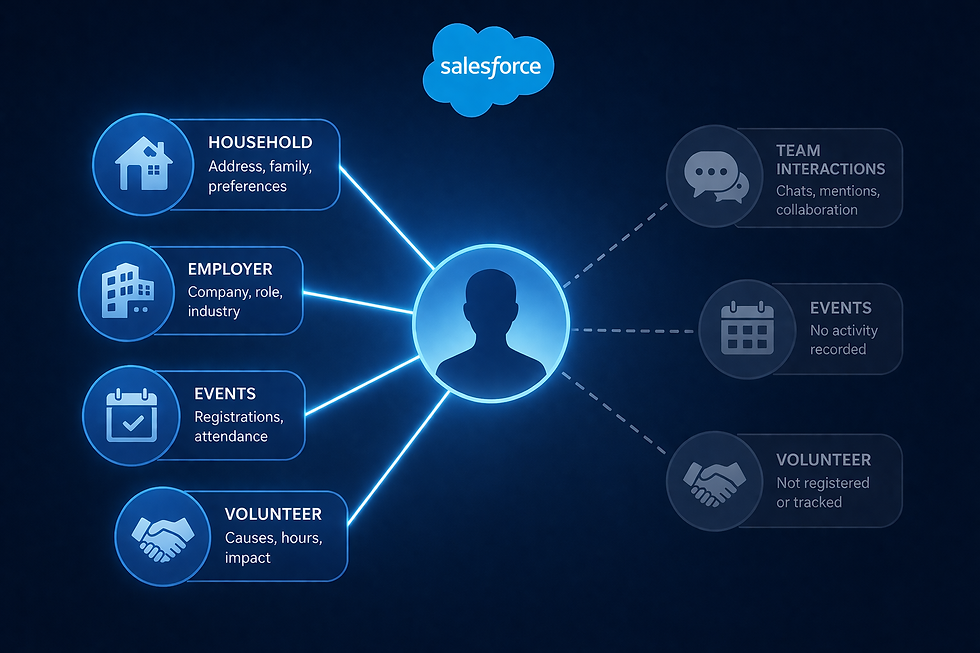
One of Agentforce’s greatest strengths is its ability to reason across relationships—connecting a contact’s giving history to their employer, household, event attendance, volunteer engagement, and any interactions with your team. For a logistics company, this might mean linking a client contact to their parent account, contract history, and open service tickets. For a financial services firm, it means linking an individual client to their household, their advisory team, and their product relationships.
If these relationships are not correctly mapped in Salesforce—contacts not properly linked to accounts, households not consolidated, related records siloed in separate objects with no clear connection—the agent loses the contextual intelligence that makes it valuable. It is like asking someone to make a complex judgment call while withholding half the relevant information.
4. Historical Completeness: The Institutional Memory Agentforce Draws From
AI agents improve their recommendations and actions when they have access to meaningful historical data. A nonprofit with five years of giving history in Salesforce is more accurate in donor cultivation recommendations than one that migrated last year and only brought over two years of data. A construction company with a complete job history—including project outcomes, team assignments, and client satisfaction data—will get more reliable resource allocation suggestions than one working from a partial picture.
Historical data migration is one of the most underinvested areas of CRM implementation. Organizations often migrate only “active” records and leave years of transactional history behind. Before Agentforce deployment, it is worth evaluating what historical data should be brought into Salesforce—and in what structure—to give the agent the richest possible foundation.
What This Looks Like Across Industries

Although data readiness challenges manifest differently across industries, the underlying dynamic is consistent: dirty data + powerful AI = fast, confident, wrong outcomes. Here's what we see across the organizations we work with.
Nonprofits: Donor Intelligence Requires Donor Data Integrity
A regional food bank recently approached us about Agentforce implementation. Their development team was excited about the prospect of AI-driven donor cultivation—personalized outreach, predictive upgrade asks, automated acknowledgment sequences. But when we audited their Salesforce instance, we found 18% duplicate contact rate, soft credits not linked to household records, and event attendance data in a disconnected spreadsheet rather than Salesforce records.
Had they deployed Agentforce without addressing these issues, the AI would have treated duplicate donors as separate mid-level prospects, missed upgrade signals from household giving patterns, and had no visibility into engagement context that event attendance provides. The result would have been outreach that felt generic at best and inappropriate at worst—precisely the opposite of the personalization Agentforce promises.
We spent eight weeks on data remediation before any AI configuration began. By the time Agentforce was deployed, the system had a clean, complete picture of every donor relationship. The cultivation recommendations it generated were accurate enough that the development director described the experience as “having a research assistant who actually read the files.”
Wealth Management: Client Relationships Are Too Valuable to Trust to Incomplete Data
For wealth management firms, the stakes around data accuracy are uniquely high. An AI agent that misreads a client’s risk profile, misses a life event trigger, or incorrectly associates household assets can generate recommendations that damage client trust and expose the firm to regulatory risk. The data foundation here is not just a technical matter—it is a fiduciary one.
Wealth management firms typically face several data integrity challenges that precede any Agentforce implementation: client households not fully consolidated in Salesforce Financial Services Cloud, life events like marriage, retirement, or inheritance not consistently captured as structured data, and relationship maps between advisors, clients, and referral sources that live in email threads rather than CRM records. Each of these gaps limits what an AI agent can accurately reason about.
Financial Services: Compliance Context Cannot Be an Afterthought
Finserv organizations deploying Agentforce need to be especially deliberate about data architecture because AI agents will act on the data structures they find. If compliance-related fields are inconsistently populated, if KYC documentation statuses are tracked informally rather than in structured Salesforce fields (or if exception handling workflows live outside the CRM), agents will either ignore compliance context or act on incorrect assumptions about it.
The work before Agentforce deployment in Finserv environments typically includes mapping every compliance-relevant data point into clearly defined, consistently populated Salesforce fields, establishing data governance policies that ensure new records are created correctly from day one, and building validation rules that prevent the kind of field inconsistency that makes AI reasoning unreliable.
Service-Based Companies: Operational Data Is as Important as Customer Data
For construction firms, logistics companies, and other service businesses, Agentforce’s value lies in operational intelligence: smarter resource scheduling, proactive client communication, automated job status updates, and predictive maintenance alerts. But these capabilities depend on operational data—job records, crew assignments, equipment status, client communication history—being complete, current, and correctly structured in Salesforce.
Let's say a regional HVAC company wanted Agentforce to proactively alert clients when their equipment is approaching service intervals— a compelling vision. But when we reviewed their Salesforce data, equipment installation dates were missing from roughly 40% of records, service histories were split between Salesforce and a legacy field service management tool, and client contact preferences were not tracked at all. The agent could not execute the use case because the data it needed to act on simply was not there.
A Balanced Perspective: Data Work Is Hard, and That’s Not a Reason to Delay

We want to be honest about something: data remediation is not glamorous work. It is not the part of the Agentforce journey that gets highlighted in keynote presentations or product demos. It is time-consuming, requires organizational patience, and often surfaces uncomfortable truths about how data has been managed (or not managed) for years.
There is also a legitimate counterargument to the “clean everything first” approach: some organizations can deploy a limited Agentforce use case against a well-defined, relatively clean subset of data to start building experience and momentum while broader data work continues in parallel. We have seen this work well when the scope is genuinely constrained and the team understands they are working with a partial dataset.
It's never a good idea to deploy Agentforce broadly against a data environment that has not been audited and remediated, with the plan of “cleaning as we go.” AI agents move fast and act at scale, thus errors compound rather than self-correct. The organizations that have tried this approach typically spend more time cleaning up the consequences of AI-driven errors than they would have spent on data remediation before deployment.
How Ohana Focus Builds the Foundation

When organizations come to us asking about Agentforce, we start with a data readiness assessment before any implementation conversation begins. This is not a sales tactic—it is the only honest way to scope what Agentforce will actually be able to do for a given organization, and how much foundational work needs to happen first. Our process follows a clear sequence:
Data Audit: We examine your current Salesforce environment—or the legacy system you’re migrating from—for duplicate rates, field inconsistency, relationship gaps, and historical data completeness. We produce a clear report of what exists, what is missing, and what is incorrect.
Data Architecture Design: We design the field structures, picklist values, object relationships, and validation rules that Agentforce will need to reason correctly. This is not a generic Salesforce configuration—it is an architecture designed specifically to support AI agent use cases relevant to your industry and organization.
Migration and Remediation: For organizations migrating from legacy systems like Raiser’s Edge, Blackbaud, or older CRMs, we handle the full migration process—including deduplication, field mapping, historical data import, and post-migration validation. For organizations already on Salesforce, we run targeted remediation campaigns against the highest-priority data problems.
Governance Setup: We establish the data governance policies, validation rules, and user training that prevent data quality from degrading after remediation is complete. Clean data is not a one-time achievement—it requires ongoing disciplines that become part of how your team uses Salesforce every day.
Agentforce Configuration and Launch: Once the data foundation is ready, we configure and deploy Agentforce agent use cases tailored to your workflows—whether that is donor cultivation automation for a nonprofit, client lifecycle management for a wealth management firm, or operational coordination for a service company.
We have done this work across sectors and understand the difference between data challenges that are quick to resolve and those that require sustained organizational commitment. And we are direct with clients about both—because setting accurate expectations is what makes Agentforce implementations succeed.
What to Do Before Deploying Agentforce

If your organization is evaluating Agentforce (or has already committed to it and is planning implementation), start with an honest data conversation. Before any vendor demo or implementation scoping call, gather your team and ask the following questions:
Do we have a reliable estimate of our duplicate rate in Salesforce?
Are our most important fields—lead source, opportunity stage, contact type, account category—consistently populated with standardized values?
Are the relationships between contacts, accounts, households, or service records correctly mapped and current?
How much relevant historical data exists outside Salesforce that an AI agent would benefit from?
If the honest answer to most of those questions is “we’re not sure,” that is exactly the right time to bring in an implementation partner who will tell you the truth about your data before you commit budget and timeline to an Agentforce rollout.
Agentforce is genuinely transformative technology. The organizations that will gain the most from it are not those that deploy fastest—they are those that build the data foundation that lets the AI do what it promises. That foundation is the work. Everything else is the reward.
Partner with Ohana Focus

Build the necessary data foundation for Agentforce alongside consultants with cross-industry expertise.
Ohana Focus is a certified Salesforce consulting partner specializing in data readiness, CRM migration, and Agentforce implementation for nonprofits, wealth management firms, financial services organizations, and service-based companies. We have helped hundreds of organizations transform their relationship with data—cleaning it, structuring it, migrating it, and ultimately deploying AI-powered workflows that actually work. We bring:
Data readiness assessments and full audit reporting
End-to-end CRM migration from Raiser’s Edge, Blackbaud, and legacy systems
Agentforce architecture design and deployment
Data governance policy development and team training
Ongoing support for complex, multi-object data environments
About Ohana Focus
Ohana Focus is a certified Salesforce consulting partner dedicated to helping nonprofits, financial services firms, and service-based companies harness the power of their data. From legacy system migration to Agentforce implementation, we make complex data simple, accessible, and actionable. Our practice has helped hundreds of organizations build the foundation for smarter operations, not just better software.


Comments