Why MuleSoft + Informatica + Agentforce Is the Integration Trifecta Your Business Has Been Waiting For
- Ohana Focus Team

- Apr 10
- 10 min read

For many organizations, the integration story is painfully familiar. Salesforce holds customer records. SAP owns financial data. A legacy ERP tracks inventory. Marketing automation lives in Marketo. Somewhere in between, overworked IT teams maintain a tangle of point-to-point connections, manual data exports, and brittle API calls written by someone who left the company three years ago. Data moves, but not reliably—not in real-time, and never quite the way the business needs it to. It works well enough, most days. Until it doesn’t.
The consequences are familiar too: reports built on yesterday’s data, customer service agents working from incomplete records, AI models trained on stale inputs, and executive teams making strategic decisions on spreadsheets assembled by hand. The data is there, just never quite where or when you need it.
Three Salesforce platforms—MuleSoft, Informatica, and Agentforce—form an integration architecture that not only solves these problems but also reimagines how enterprises connect, govern, and act on data entirely. Together, they form a trifecta that turns fragmented data infrastructure into a living, intelligent nervous system.
The Integration Problem No One Wants to Admit

Ask any enterprise IT leader to describe their data landscape honestly, and the picture looks less like a well-architected system and more like geological layers—decades of technology decisions compounding on top of each other.
There’s the cloud-native layer added in the last five years. Underneath it, the middleware suite was implemented before that. Below that is the legacy database that's been running since before anyone on the current team was hired. Each layer made sense at the time. Together, they create a maintenance burden that consumes engineering capacity, delays business initiatives, and makes even simple data requests feel like archaeology. The average enterprise manages over 900 applications. Less than 30% of them share data effectively with the rest of the ecosystem.
The symptoms are easy to recognize: duplicated customer records across systems, analytics teams waiting days for data pipeline refreshes, and AI initiatives stalled because the training data can’t be trusted. The root cause is almost always the same—data architecture built for a previous era, patched and extended until it buckles under the weight of modern expectations. MuleSoft, Informatica, and Agentforce don’t patch this architecture—they replace the thinking behind it.
What Each Platform Actually Does
MuleSoft: The Integration Backbone
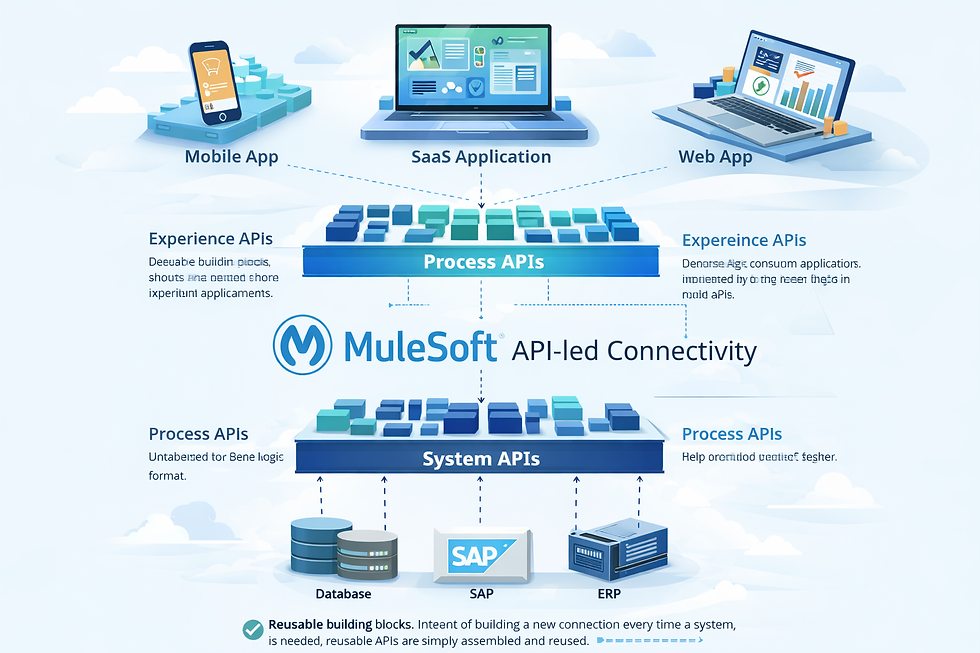
MuleSoft is an integration platform built around a concept called API-led connectivity. Rather than building direct, brittle connections between individual systems, MuleSoft creates a structured layer of reusable APIs organized into three tiers: system APIs that connect to underlying data sources, process APIs that implement business logic, and experience APIs that deliver data in the format each consuming application needs.
The practical effect is significant. Instead of building a new connection every time a business unit needs data from a different system, MuleSoft creates reusable building blocks. The first time someone needs customer data from SAP, an API gets built. The second time—and every time after that—they simply reuse it. Integration work that previously required months of custom development begins to feel more like assembling components.
Key capability: Anypoint Platform provides a unified environment for designing, building, deploying, and monitoring integrations—with prebuilt connectors for hundreds of enterprise systems, including Salesforce, SAP, Workday, Netsuite, and legacy mainframes.
Informatica: The Data Intelligence Layer

Informatica solves a different but equally critical problem: not just moving data, but making sure it’s worth moving in the first place. Its IDMC (Intelligent Data Management Cloud) platform handles data quality, data governance, master data management, and data cataloging—all powered by a metadata intelligence engine called CLAIRE AI.
This matters more than it sounds. A customer record is only useful if it’s accurate, complete, and consistent across systems. An AI model is only trustworthy if it’s trained on clean, governed data. A compliance report is only valid if the data underlying it can be traced back to its source. Informatica provides the infrastructure that makes data trustworthy—not just available.
Key capability: CLAIRE AI automatically classifies data assets, identifies quality issues, suggests remediation steps, and builds data lineage maps that show exactly where every piece of information came from and how it’s been transformed—at enterprise scale.
Agentforce: The Intelligent Action Layer

Agentforce is Salesforce’s autonomous AI agent platform. Where traditional automation executes predefined workflows, Agentforce deploys AI agents that can reason through complex, multi-step tasks—drawing on real-time data, organizational context, and natural language understanding to take action without requiring human intervention at every step.
An Agentforce agent doesn’t just surface information. It retrieves the right data, interprets it in context, determines the appropriate next action, executes that action across connected systems, and loops back to verify the outcome. For tasks that previously required a human to navigate between five different applications, an agent handles the orchestration autonomously.
Key capability: The Atlas Reasoning Engine enables agents to break complex requests into sub-tasks, select appropriate tools and data sources for each, chain actions together across systems, and self-correct when initial approaches don’t yield the right result.
The Trifecta in Action: Where 1 + 1 + 1 = 10
Each platform is powerful in isolation. The combination is something categorically different.
Consider what happens when a major enterprise deploys all three:
MuleSoft ensures that data flows reliably between every system in the enterprise—from legacy ERPs to cloud platforms to external partner APIs. Every source of record becomes accessible through a structured, reusable API layer.
Informatica ensures that data is clean, governed, and trustworthy before it moves or gets used. Duplicate records get reconciled. Data quality rules get enforced automatically. Compliance teams can trace every data element back to its origin.
Agentforce ensures that clean, connected data gets put to work intelligently—with AI agents that can query the right systems, synthesize information across sources, and take meaningful action without waiting for human orchestration.
Customer Service Transformation
A financial services firm runs customer service across Salesforce Service Cloud, a core banking platform, a loan origination system, and a compliance database. Currently, when a customer calls about a loan discrepancy, the agent manually logs into three separate systems, compiles information, escalates to a specialist, and resolves the issue in 4–6 business days.
With the trifecta:
MuleSoft connects the core banking platform, loan origination system, and compliance database to Salesforce via governed APIs
Informatica ensures customer records are deduplicated and enriched across all four systems—the agent sees one authoritative view of the customer
An Agentforce agent autonomously retrieves the loan record, identifies the discrepancy, cross-references compliance rules, drafts a resolution, and either resolves it automatically or escalates with a complete brief—in minutes, not days
Outcome: Average handle time drops from days to minutes. Customer satisfaction improves. Compliance risk decreases because every action is logged and auditable.
Supply Chain Intelligence
A manufacturing company struggles with inventory decisions because data lives across an ERP, a logistics platform, and supplier portals—none of which talk to each other in real-time. Procurement teams export spreadsheets at the end of the week, by which point the data is already stale.
With the trifecta:
MuleSoft creates real-time API connections to the ERP, logistics systems, and supplier portals
Informatica governs the data, reconciling part numbers and supplier records across systems that use different identifiers
Agentforce agents monitor inventory levels continuously, identify risk signals (a supplier running low, a logistics delay, a demand spike), and proactively surface recommendations—or take pre-approved actions like reordering—before a problem becomes a crisis
Outcome: Supply chain decisions shift from reactive and weekly to proactive and continuous. Stockouts decrease. Procurement capacity redirects from reporting to strategy.
The Data Trust Problem—and Why It’s Bigger Than You Think

Organizations often underestimate how much of their AI ambition is blocked not by a lack of models, but by a lack of trusted data. An AI agent is only as reliable as the data it draws on. If customer records contain duplicates, if product data is inconsistently labeled across systems, if financial figures haven’t been reconciled against the source of record, the agent will confidently act on wrong information. The failure mode isn’t a hallucination. It’s a convincingly wrong answer, executed autonomously at scale.
Informatica’s Master Data Management capability creates golden records—single, authoritative versions of key entities like customers, products, and suppliers—that reconcile conflicting data from multiple systems according to governance rules the organization defines. Those golden records become the trusted inputs that Agentforce agents use to make decisions and take action.
Without this layer, autonomous AI is risky. With it, autonomous AI becomes a genuine enterprise asset.
Democratizing Integration—Beyond the IT Department

One of the most significant shifts the trifecta enables has nothing to do with technology. It’s about who can participate in integration.
In the traditional model, integration is exclusively an IT function. Business units submit requests. IT queues them, scopes them, estimates them, and delivers them months later. By then, the business need may have changed. MuleSoft’s low-code tooling, Informatica’s self-service data catalog, and Agentforce’s natural language agent builder change this dynamic fundamentally.
A marketing analyst can explore the Informatica catalog to find and understand available data assets without opening a ticket
A sales operations manager can build a custom Agentforce agent for their team’s specific workflow without writing code
A finance team can monitor data quality dashboards and flag issues directly, rather than discovering data problems after a bad report
When the people closest to business problems can engage directly with data infrastructure—with guardrails that IT defines centrally—organizations move faster without sacrificing governance. The integration bottleneck shrinks. The business becomes genuinely more agile.
The ROI Case: What Organizations Actually Experience
The business case for the trifecta is concrete, not theoretical. Organizations that have deployed integrated MuleSoft, Informatica, and Salesforce AI capabilities consistently report results across several dimensions.
Reduced time-to-integration: Reusable MuleSoft APIs cut the time required to connect a new system from months to days or weeks. IT capacity that previously went to building bespoke integrations shifts to higher-value architecture work.
Improved data quality ROI: Informatica customers routinely report significant reductions in the cost associated with bad data—customer communications sent to wrong addresses, duplicate records consuming storage, and compliance findings triggered by inconsistent data.
AI initiative acceleration: Organizations report that Agentforce implementations supported by clean, connected data go from proof-of-concept to production in weeks rather than quarters. The data readiness work Informatica enables is frequently the critical path item.
Staff capacity reclaimed: When AI agents handle the orchestration and data retrieval tasks that previously required human navigation between systems, teams redirect that capacity toward the work that genuinely requires human judgment—strategy, relationship management, complex problem-solving.
The Learning Curve Reality

Organizations considering the trifecta sometimes hesitate because three enterprise platforms feel like three implementation projects. The concern is understandable. The reality is more nuanced.
Each platform has its own onboarding arc. MuleSoft has real depth—becoming a proficient integration developer takes time. Informatica’s governance framework requires careful thought about data ownership and stewardship roles. Agentforce agent-building requires understanding how to scope agent tasks appropriately and define the guardrails that make autonomous action safe.
The key insight is that these platforms are designed to grow with an organization. A phased approach works well: start with the highest-pain integration using MuleSoft, establish data quality foundations for the most critical data domain with Informatica, and build the first Agentforce agent for the highest-value use case. Each success builds organizational confidence and capability. The organizations that struggle are those that attempt to boil the ocean—implementing everything simultaneously across every department. The organizations that succeed start focused, demonstrate value quickly, and expand from a foundation of working capability.
Making the Mental Shift
The deeper challenge of adopting the trifecta isn’t technical. It’s conceptual.
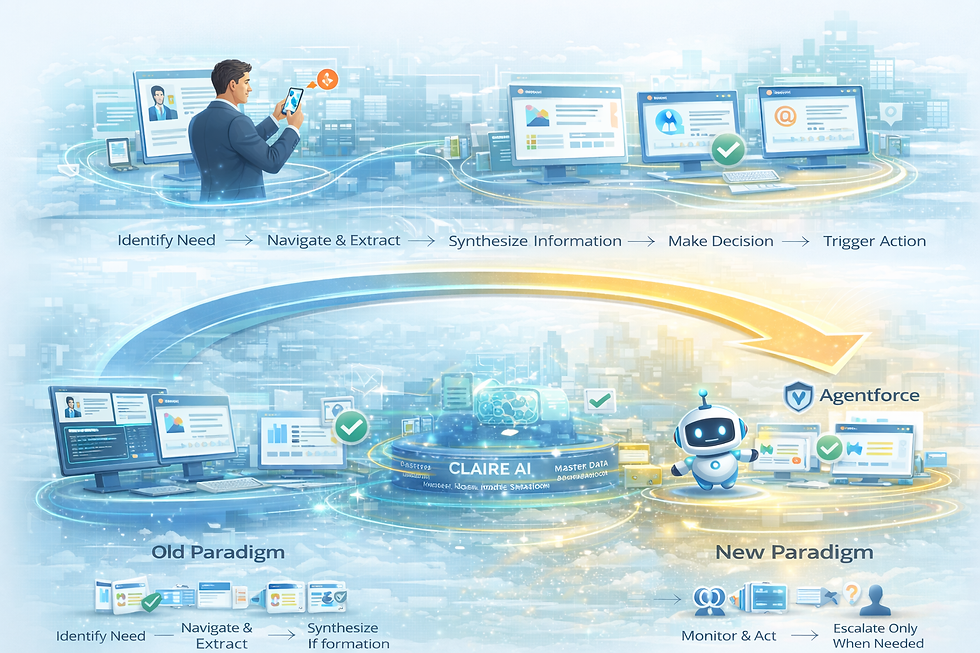
Most enterprise technology thinking is built around systems of record—places where data lives. The MuleSoft/Informatica/Agentforce architecture requires shifting toward a different mental model: systems of intelligence, where data flows continuously between sources, gets refined and governed in transit, and gets acted on by agents that never need to be told to check. In the old paradigm, a business process looks like this: a human identifies a need, navigates to the right system, extracts the relevant data, synthesizes it with information from other sources, makes a decision, and then manually triggers an action in one or more downstream systems.
In the new paradigm, Agentforce agents continuously monitor relevant data streams, identify triggering conditions, synthesize information across systems through MuleSoft’s API layer, validate that data against Informatica’s quality standards, and act—escalating to a human only when the situation genuinely requires judgment. This shift takes time to internalize. Organizations should expect a period of adjustment where teams build confidence in autonomous action incrementally, starting with low-risk decisions and expanding as trust develops. That patience is worth it.
What This Means for Your Organization
The case for the MuleSoft + Informatica + Agentforce trifecta ultimately isn’t about technology. It’s about what becomes possible when data infrastructure stops being a bottleneck and starts being a competitive advantage.
Faster decisions: When Agentforce agents surface real-time intelligence rather than periodic reports, executives can respond to changing conditions in hours rather than weeks.
Better decisions: When Informatica ensures the data underlying those decisions is clean, governed, and traceable, confidence in the decisions themselves goes up.
More autonomous operations: When MuleSoft connects every relevant system, and Agentforce can act across all of them, organizations can scale operations without proportionally scaling headcount.
Reclaimed human potential: When AI handles the repetitive, data-heavy orchestration work, people redirect their energy toward the problems that genuinely require human creativity, empathy, and judgment.
The technical benefits—faster integration, cleaner data, more capable AI—are real. But the organizational benefits—better strategy, deeper competitive differentiation, a workforce freed from data plumbing—are transformational.
Moving Forward

For organizations ready to explore what the trifecta can do for them, the path forward starts with an honest assessment of where the current integration architecture is failing the business—not as a technical exercise, but as a business conversation.
Where are decisions delayed because data isn’t available? Where are AI initiatives stalled because data quality can’t be trusted? Where are your best people spending time on work that could and should be automated?
The answers to those questions define where to start. Pick the highest-value problem. Build the initial integration. Demonstrate the impact. Then expand from a position of demonstrated capability, not speculative ambition. The trifecta isn’t a project. It’s an architecture. And like the best architectures, it gets more valuable the more you build on top of it.
That transformation is worth the learning curve.
Partner with Ohana Focus

Build the integration architecture your AI ambitions require. Schedule your free consultation today.
Ohana Focus specializes in helping enterprises design and implement MuleSoft, Informatica, and Agentforce architectures that work together—not just individually. We understand both the technical complexity of enterprise integration and the organizational dynamics of getting these platforms adopted effectively. We bring:
Integration architecture design and MuleSoft implementation
Informatica data quality, governance, and MDM deployment
Agentforce agent design, build, and enablement
Cross-platform roadmap development and phased rollout planning
Ongoing optimization and support for complex enterprise environments
About Ohana Focus
Ohana Focus is a certified Salesforce consulting partner dedicated to helping organizations build data infrastructure that drives real business outcomes. We believe integration isn’t a technical problem—it’s a strategic one. Our team brings deep expertise across MuleSoft, Informatica, and the full Salesforce platform to help clients connect their data, govern it, and put it to work intelligently.


Comments