Not Just Automation: How Salesforce Agentforce Is Redefining Productivity Across Every Industry
- Ohana Focus Team

- Apr 1
- 7 min read

Across industries, the pattern repeats itself: capable professionals focused on work that matters, yet pulled away by routine tasks and administrative overhead. A wealth manager devotes hours on a Friday afternoon to assembling portfolio summaries by hand instead of getting ready for client conversations. A logistics dispatcher juggles constant status calls that a well-designed system could handle instantly. A nonprofit development officer moves donor data from one spreadsheet to another when that time could be spent deepening relationships and advancing the mission.
These aren’t isolated inefficiencies. They’re symptoms of a deeper challenge: the tools organizations use to manage data don’t actively work alongside the people using them. They store information and report on it—but they don’t reason, anticipate, or act.
That’s precisely the gap that Salesforce Agentforce is designed to close. Built directly into the Salesforce platform, Agentforce is a suite of customizable AI agents that work autonomously across departments and industries—handling tasks, surfacing insights, engaging stakeholders, and escalating decisions to humans when real judgment is required. This isn’t automation in the traditional sense. It’s a shift in how work gets done.
What Agentforce Actually Is (and Isn’t)
It’s worth being clear about what Agentforce does—and being honest about what it doesn’t. Unlike rule-based automation tools that execute fixed sequences of actions, Agentforce agents use large language models to understand context, interpret intent, and take adaptive action within guardrails that your organization defines. They can read records, draft communications, trigger workflows, update data, and interact with customers or staff—all without constant human prompting.
That said, Agentforce isn’t a plug-and-play product that works out of the box. Agents need to be configured with knowledge sources, action permissions, and escalation rules. Organizations that invest in thoughtful implementation—with clear use cases, clean data, and proper governance—see compelling returns. Organizations that rush deployment without that foundation tend to be disappointed. With that honest framing in place, let’s look at what Agentforce makes possible across industries where we see the greatest impact. For a deeper look into why clean data is essential, check out yesterday's post.
Nonprofits: From Data Overload to Donor-Centered Operations

Nonprofits operate in a paradox: they’re mission-driven organizations with immense relationship data, yet much of that data sits underutilized while staff manage administrative backlogs. Development teams often spend more time preparing for donor conversations than having them.
Where Agentforce Changes the Equation
Imagine a mid-size regional food bank with a development team of four. Before an annual gala, the team historically spent two to three weeks pulling donor histories, segmenting by giving tier, drafting personalized asks, and coordinating follow-up assignments. With an Agentforce-powered workflow, an AI agent can surface each major donor’s giving history, engagement touchpoints, and estimated capacity—then draft a personalized outreach sequence for each development officer to review and send. What took three weeks now takes three days.
Beyond fundraising, Agentforce agents can handle incoming donor inquiries through chat or email, answer questions about impact and financials, route complex requests to the right staff member, and log every interaction automatically in Salesforce NPSP. Program staff can use agents to track participant outcomes, flag cases requiring follow-up, and surface grant compliance data on demand.
The result isn’t just efficiency—it’s capacity. Nonprofits can grow their programs without proportionally growing their administrative burden. For resource-constrained organizations, that’s transformative.
Wealth Management: Personalization at Scale Without the Overhead

Wealth management firms face a structural tension: clients expect highly personalized service, but advisors can only maintain so many deep relationships before the quality of attention starts to slip. Junior advisors spend disproportionate time on administrative work. Senior advisors find themselves in reactive mode—responding to client requests rather than proactively driving strategy.
A Day in the Life with Agentforce
Consider a hypothetical RIA firm with 12 advisors managing 400 client relationships. Previously, quarterly review preparation consumed roughly eight hours per advisor per quarter—pulling performance data, drafting talking points, and reviewing life event notes. With Agentforce configured to aggregate client data, generate review summaries, and flag clients with significant portfolio drift or upcoming life events, that same prep now takes closer to 90 minutes.
Agentforce agents can also proactively monitor client accounts and alert advisors when certain thresholds are crossed—a large withdrawal that might signal dissatisfaction, a birthday milestone that creates a gifting planning opportunity, a market event relevant to a specific client’s allocation. Rather than waiting for clients to call, advisors are positioned to reach out first.
There are real compliance and data governance considerations in this industry that require careful attention during implementation. Agentforce doesn’t eliminate those requirements, but when configured properly within compliance guardrails, it gives advisors the time to focus on what actually drives client retention: genuine relationship depth.
Financial Services Companies: Faster Decisions, Fewer Bottlenecks

Banks, credit unions, insurance companies, and lending institutions share a common operational challenge: high-volume, process-intensive workflows where small delays compound quickly. A loan application that takes two weeks to process instead of three days doesn’t just frustrate an applicant—it can cost the institution the relationship entirely.
Intelligent Triage Across the Customer Journey
Agentforce can be deployed across every stage of the customer journey in financial services. On the front end, AI agents handle initial inquiries, pre-qualify leads, answer product questions, and collect application information—routing complex cases to human specialists only when required. On the back end, agents can monitor open cases, prompt follow-up when timelines slip, and automatically generate status communications to keep customers informed.
In a hypothetical community bank scenario, a mortgage team handling 80 applications per month might spend a significant portion of their week sending manual status updates and chasing missing documents. An Agentforce agent can automate both: monitoring application stages, sending targeted reminders to applicants when documents are missing, and escalating to the loan officer only when human judgment is needed. Processing times drop. Customer satisfaction improves. Loan officers spend their time on decisions, not correspondence.
Fraud detection teams can similarly leverage Agentforce to surface unusual patterns for human review, rather than manually auditing transaction logs—a use case where the combination of AI triage and human judgment is particularly powerful.
Construction and Logistics: Field Operations Finally Connected to the Office

Service-based industries like construction and logistics have always faced the same core problem: critical information lives in disconnected places. Project managers know what’s happening in the field, but that knowledge rarely flows cleanly into the systems operations and finance teams need. Dispatchers know delivery status, but customers are left calling to find out. Subcontractor coordination happens over text and email threads that no CRM ever sees.
Construction: From Reactive to Proactive Project Management
In a hypothetical commercial general contractor scenario, a project manager overseeing multiple simultaneous builds might spend hours each week compiling status reports from subcontractors, updating client-facing schedules, and chasing material lead times. With Agentforce integrated into a Salesforce-based project management setup, an AI agent can aggregate field updates, flag schedule risks based on current progress, and draft client status communications for the PM to review and send.
Bid and proposal workflows are another high-value target. Agentforce agents can pull historical project data, summarize relevant experience, and draft initial proposal sections—turning a multi-day effort into a multi-hour one. Estimators can focus on the judgment-intensive portions of a bid rather than reformatting boilerplate.
Logistics: Proactive Communication Instead of Reactive Fire-Fighting
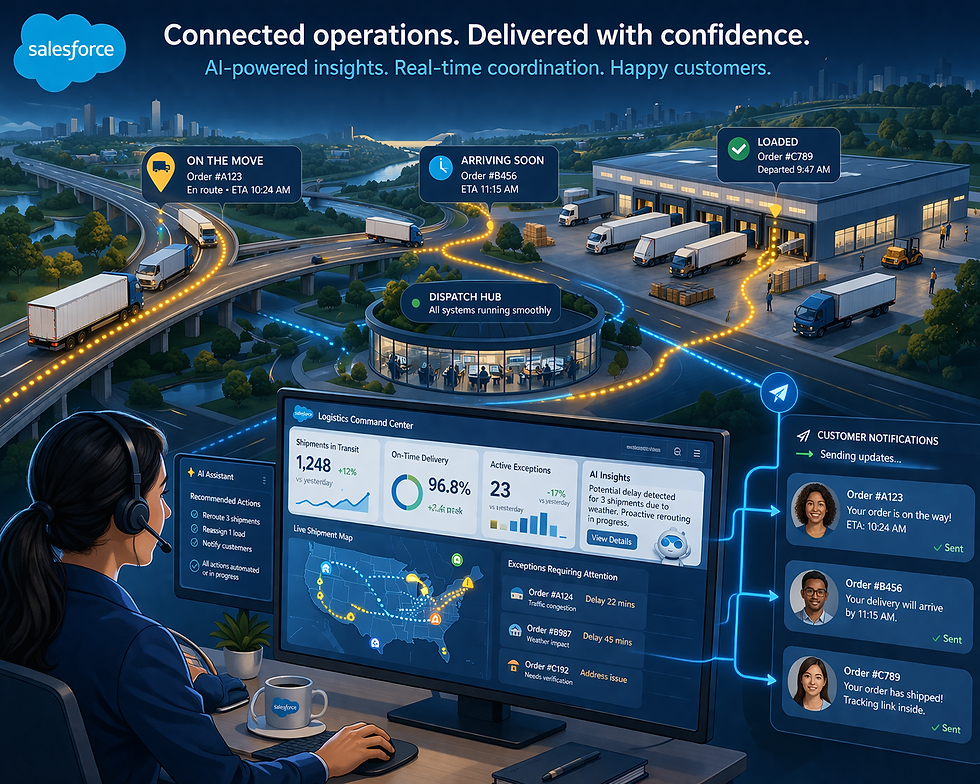
For logistics and freight companies, customer-facing communication is often the most labor-intensive part of operations. Dispatchers field inbound status inquiries while simultaneously managing exceptions and rerouting. Agentforce agents can handle the inquiry side of that equation—responding to customer questions about shipment status, providing proactive delay notifications, and only escalating to human dispatchers when exceptions require real decision-making.
Internally, agents can assist with route optimization recommendations, carrier performance summaries, and compliance documentation—all areas where the value isn’t in human effort, but in having accurate information available at the right moment.
An Honest Assessment: Where Agentforce Shines and Where to Proceed Carefully

Any vendor-neutral discussion of Agentforce has to acknowledge that it’s not a universal solution. Here’s where we’ve seen it work best—and where organizations should think carefully before diving in.
Where It Works Well
High-volume, repeatable interactions where human bandwidth is the bottleneck (donor inquiries, customer status updates, intake workflows)
Tasks that require aggregating information from multiple Salesforce records before human action (pre-meeting prep, report generation, compliance summaries)
Organizations with reasonably clean, structured Salesforce data—Agentforce performs best when the underlying data is reliable
Teams ready to invest in clear governance: defining what agents can and cannot do, reviewing outputs initially, and building trust incrementally
Where to Proceed Carefully
Organizations with fragmented or poorly maintained Salesforce data—agents trained on bad data will confidently surface wrong answers
High-stakes decisions that require nuanced human judgment and accountability (final lending decisions, sensitive donor conversations, complex compliance determinations)
Teams expecting immediate ROI without implementation investment—like any enterprise software, the value scales with the quality of the setup
Making the Shift: What a Thoughtful Agentforce Rollout Looks Like

The organizations that get the most from Agentforce share a common implementation approach: they start with one high-value, well-defined use case, prove it out, then expand deliberately.
A logical first step for most organizations is identifying a task that consumes disproportionate staff time, involves structured and reliable Salesforce data, and doesn’t require sensitive human judgment as its primary output. Donor inquiry response for nonprofits, quarterly review prep for wealth managers, application status communication for lenders, and shipment tracking responses for logistics companies all fit that profile well.
From there, the question is configuration quality: What knowledge sources does the agent need? What actions is it permitted to take? What should always be escalated to a human? Getting those guardrails right at the start saves significant rework later.
Organizations should also think carefully about change management. Agentforce doesn’t eliminate jobs—but it does change them. Staff who once spent their days on administrative processing will shift toward more complex, judgment-intensive, and relationship-focused work. That’s generally a positive shift, but it requires communication, training, and honest conversation about what changes.
Partner with Ohana Focus

At Ohana Focus, we specialize in helping nonprofits, financial services firms, wealth management practices, and service-based businesses implement Salesforce solutions that actually deliver—including Agentforce deployments designed around real organizational needs, not demo scenarios.
We’ve seen what happens when Agentforce is configured thoughtfully versus when it’s rushed into production. The difference between those two outcomes usually comes down to use-case clarity, data quality, and governance design—exactly the areas where our team spends the most time with clients. We bring:
Agentforce implementation and configuration expertise
Industry-specific use case development across nonprofits, financial services, wealth management, and service-based industries
Data readiness assessments to ensure your agents are working from reliable information
Governance frameworks that keep AI agents working within appropriate boundaries
Ongoing support as your use cases evolve and expand
If your organization is evaluating Agentforce—or trying to figure out whether it’s the right fit at all—we’re here for that conversation.
About Ohana Focus
Ohana Focus is a certified Salesforce consulting partner dedicated to helping organizations across industries harness the full power of their data and their CRM investment. From Salesforce NPSP implementations for nonprofits to Financial Services Cloud deployments and Agentforce rollouts, we bring the technical depth and real-world experience to make complex projects work—and stick.
Our team understands that technology is only as valuable as the people who use it confidently. We combine implementation expertise with practical training and strategic guidance, so your organization doesn’t just go live—it moves forward.


Comments