Why MuleSoft + Informatica + Agentforce Is the Integration Trifecta Your Business Has Been Waiting For
- Ohana Focus Team

- Mar 27
- 9 min read

Imagine three incredibly talented musicians, each exceptional in their own right. Individually, they perform well. But the moment they play together with a shared score, listening to one another, building on what the others contribute, the music becomes greater than the sum of its parts.
That's the best way to understand the combination of MuleSoft, Informatica, and Agentforce. Each platform is powerful on its own—MuleSoft connects systems and APIs, Informatica manages and governs data quality, and Agentforce deploys intelligent AI agents that take autonomous action across your business. When organizations try to run all three in isolation, it's like three different instruments playing three different songs. But when these platforms are properly integrated—sharing data, governed by unified policies, and orchestrated by AI that actually understands what is happening across the enterprise—organizations unlock a level of operational intelligence that is not possible any other way.
This is not a pitch for technology's sake—the businesses and nonprofits that will outperform over the next decade will be the ones that make faster, smarter decisions and act on them before competitors even finish running their Monday morning reports. The MuleSoft + Informatica + Agentforce combination is, frankly, the most capable path we have seen to getting there. Here's why.
The Problem: Your Data Is Everywhere, and Your Systems Don't Communicate

Before understanding why this combination matters, it helps to be honest about the problem it solves. Most organizations—regardless of size—are running on a fragmented data landscape. Salesforce CRM on one side. An ERP or financial system on another. A marketing automation platform somewhere else. Legacy databases that predate half your current staff. Cloud storage here, on-premise servers there.
Each of these systems works reasonably well in isolation. The problem is that real business decisions—the strategic ones that actually matter—require synthesizing information across all of them simultaneously. And that synthesis rarely happens cleanly. Instead, you get data exports that are already stale by the time they land in someone's inbox. You get IT tickets backed up for three weeks because a department needs a one-time data pull. You get AI tools that generate confident-sounding outputs based on incomplete or inconsistent data.
MuleSoft addresses the connectivity layer. Informatica addresses the data quality and governance layer. Agentforce operates at the intelligence and action layer. Stack them properly, and the fragmentation problem does not just get reduced—it fundamentally goes away.
MuleSoft: The Connective Tissue of Your Enterprise

MuleSoft is Salesforce's integration platform, and its core purpose is deceptively straightforward: make any system talk to any other system. In practice, this means building APIs (Application Programming Interfaces) and integration flows that allow data to move in real time—or on a defined schedule—between the various platforms, databases, and services your organization relies on.
What MuleSoft Actually Does
Think of MuleSoft as the highway system connecting your organization's cities. Without it, getting data from your ERP to your CRM might require a manual export, a CSV transformation, and a carefully timed import—a process that is error-prone, slow, and dependent on whoever knows the arcane steps involved. With MuleSoft, that same data flows automatically through a governed, monitored integration layer.
MuleSoft's Anypoint Platform provides the following:
Pre-built connectors for hundreds of common enterprise systems (SAP, Workday, Netsuite, legacy databases, and more)
API management so integrations are documented, versioned, and secure
Real-time and batch data synchronization, depending on what each use case requires
Monitoring dashboards so IT teams can see integration health without digging through logs
For organizations already in the Salesforce ecosystem, MuleSoft integration feels particularly natural—but it is emphatically not limited to Salesforce-to-Salesforce connections. Its strength is precisely that it connects everything.
Informatica: Ensuring the Data You Move Is Data You Can Trust
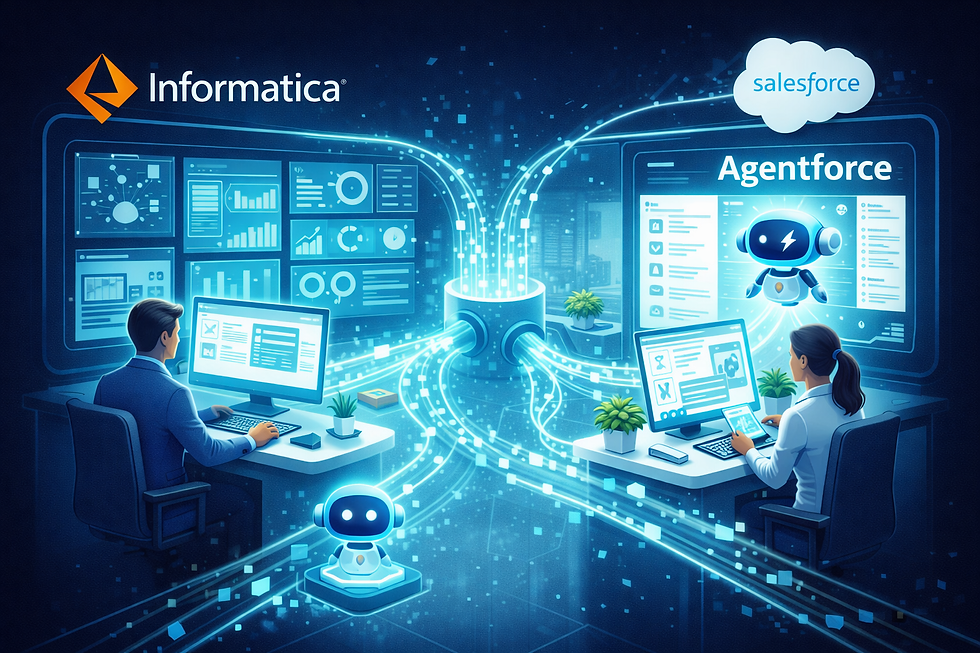
Here is a scenario that plays out constantly in organizations that have invested in integration but skipped data governance: they successfully connected all their systems, and now bad data flows everywhere instantly. Duplicate customer records. Inconsistent naming conventions. Fields populated with whatever someone typed on a Tuesday afternoon five years ago. Integrations that move data faster are only valuable if the underlying data is reliable. This is where Informatica enters the picture—and why its role in this trifecta is irreplaceable.
What Informatica Actually Does
Informatica is the leading enterprise data management platform, covering everything from data integration and quality to master data management (MDM) and data governance. In the context of this trifecta, it functions as the quality control layer that ensures everything MuleSoft moves is accurate, consistent, and trustworthy.
Practically, Informatica handles:
Data quality rules that catch and flag inconsistencies before they propagate across systems
Master data management so that 'Acme Corporation' in your CRM and 'ACME Corp.' in your ERP are understood to be the same entity
Data lineage tracking—the ability to see exactly where a piece of data came from and how it has changed
Governance frameworks that help organizations meet compliance requirements (GDPR, HIPAA, and others) without treating compliance as an afterthought
AI-powered data discovery that surfaces data quality issues proactively, before they cause downstream problems
Informatica's CLAIRE (Cloud AI and Machine Learning-Driven Intelligence Engine) applies machine learning to automate data cataloging and quality tasks that would otherwise require armies of data stewards. For organizations that have tried to solve data quality problems manually, this is a significant step change.
Agentforce: The Intelligence Layer That Turns Data Into Action

Agentforce is Salesforce's autonomous AI agent platform, and it represents something meaningfully different from the AI tools most organizations have experimented with. It is not a chatbot bolted onto a sidebar. It is not a report-generation assistant. Agentforce deploys AI agents that can reason across your organizational data, take multi-step actions, and complete complex tasks—with defined guardrails—without requiring a human to manually trigger each step.
What Agentforce Actually Does
Consider a concrete example. A sales operations leader wants to know which enterprise accounts show signs of churn risk based on support ticket volume, product usage decline, and contract renewal timelines. In a traditional environment, answering this question requires a data analyst to pull from three different systems, build a model, and produce a report—a process that might take several days.
With Agentforce operating on top of clean, connected data, an AI agent can identify those at-risk accounts automatically, surface them in the account team's workflow, draft personalized outreach recommendations, and flag the renewal manager for high-priority follow-up—all without a manual trigger. This capability extends across functions:
Service teams can deploy agents that resolve common customer issues end-to-end, escalating only when genuinely needed
HR departments can automate onboarding workflows that touch multiple systems simultaneously
Finance teams can configure agents that monitor for anomalies, flag exceptions, and route approvals automatically
Fundraising and program teams at nonprofits can receive AI-surfaced insights about donor behavior or program outcomes without running a single manual report
The keyword throughout is 'action.' Agentforce is not an analytics layer. It is an operational layer that takes your data, reasons about it, and does something with it.
Why the Combination Is Greater Than the Sum of Its Parts
Here is the critical insight that organizations sometimes miss: each of these platforms has limitations when operating on its own, and those limitations are precisely what the others address.
MuleSoft without Informatica moves data fast—but bad data moves faster. If your customer records are duplicated across systems, MuleSoft will efficiently replicate that duplication everywhere. You have solved the connectivity problem while making the data quality problem worse at scale.
Informatica without MuleSoft governs data that may never reach the systems that need it. You can have the cleanest, best-catalogued master data in your industry, but if it still lives in a silo that your Salesforce teams cannot access in real time, the governance investment does not translate to operational value.
Without MuleSoft and Informatica, Agentforce is just intelligent action built on an unstable foundation. AI agents are only as good as the data they reason over. An agent operating on incomplete, inconsistent, or siloed data will produce confident-sounding outputs that are quietly wrong—which, in an operational context, is arguably worse than no AI at all.
Together, the sequence becomes elegantly simple:
MuleSoft connects every system, creating a unified data flow across the enterprise
Informatica governs that flow, ensuring data is clean, consistent, and trustworthy as it moves
Agentforce operates on the resulting foundation, taking intelligent action based on reliable, complete information
The result is an organization that does not just have access to data—it has an enterprise that actively uses data to operate smarter, faster, and more responsively than competitors still wrestling with spreadsheet exports and manual reporting cycles.
What This Looks Like in Practice
For a Mid-Market B2B Company
A company with 200 employees runs Salesforce for CRM, NetSuite for ERP, and a separate marketing automation platform. Historically, reconciling customer data across these three systems has required a dedicated operations analyst spending 30% of their week on data hygiene and manual syncs.
With MuleSoft managing real-time integrations between all three platforms, Informatica governing the master customer record and flagging quality issues automatically, and Agentforce monitoring account health signals across all data sources, that analyst now spends their time on strategic analysis rather than data plumbing. Agentforce agents surface renewal risks before they become churn events. Sales operations has a single, trusted view of every account. The same data that used to arrive three days late—if at all—now informs decisions in real time.
For a Nonprofit Organization
A nonprofit runs Salesforce Nonprofit Cloud (NPC) for donor management, a separate program database for service delivery tracking, and a grant management system that does not natively integrate with either. Development staff spends significant time pulling data from three systems to prepare reports for the board and grant funders.
After implementing this trifecta, donor records, program outcomes, and grant deliverables live in a governed, connected data environment. Agentforce agents proactively surface major donors who have recently engaged with programs—creating warm outreach opportunities that would previously have been invisible. Board reports that used to take three hours to assemble update automatically. Grant compliance data is always current and audit-ready.
What to Watch For

We would be remiss to minimize the real considerations involved in deploying this combination. A few things worth naming directly:
The Investment Is Real
MuleSoft, Informatica, and Agentforce are enterprise-grade platforms with enterprise-grade pricing. Organizations need to be clear-eyed about total cost of ownership—including licensing, implementation, ongoing administration, and training. For smaller organizations, the calculus may not favor all three immediately. A phased approach that starts with one or two components and builds toward the full trifecta often makes more financial sense than a simultaneous deployment.
Implementation Complexity Requires Expertise
These platforms are not plug-and-play. Configuring MuleSoft integration flows, designing Informatica governance policies, and building Agentforce agents that behave correctly in production requires people who understand both the technical architecture and the specific business context of your organization. Attempting to implement without experienced guidance typically produces results that underperform what a well-scoped implementation would achieve—and sometimes creates technical debt that is costly to unwind.
Change Management Matters as Much as Technology
The most sophisticated integration stack in the world is not useful if the people who are supposed to use it revert to their existing habits. Staff need to understand why their data workflow is changing, what they gain from it, and how to take advantage of new capabilities. Organizations that invest in change management alongside technical implementation consistently see better adoption and faster time-to-value.
Next Steps

If this trifecta sounds compelling but the scope feels overwhelming, here is a practical path forward.
Start with an integration audit. Before any platform decision, map your current data landscape: which systems exist, how they currently exchange data (or do not), and where the most painful manual processes live. This audit will surface the highest-value integration opportunities and give you a defensible business case for investment.
Identify your worst data quality pain point. Most organizations have at least one area where dirty data is causing real problems—duplicate customer records, inconsistent reporting, and compliance gaps. Starting with Informatica's governance capabilities in that specific area delivers rapid, visible ROI and builds organizational confidence in the broader data management initiative.
Define one high-value Agentforce use case. Rather than trying to automate everything simultaneously, identify one business process where AI-driven action would have a clear, measurable impact. Build that use case well, measure the results, and let the success build momentum for broader deployment.
Partner with people who have done this before. The implementation journey for this combination of platforms is not one where trial and error is cost-effective. Working with a consulting partner who has navigated MuleSoft integrations, Informatica governance deployments, and Agentforce implementations across multiple organizations dramatically compresses the learning curve and reduces the risk of expensive course corrections.
Partner with Ohana Focus

Build your integration trifecta with expert guidance.
Ohana Focus specializes in helping organizations design, implement, and optimize the MuleSoft + Informatica + Agentforce stack. We understand these platforms technically—and we understand the business realities that determine whether an integration initiative actually delivers value or just adds complexity. We bring:
MuleSoft integration architecture and implementation
Informatica data governance and master data management design
Agentforce agent configuration and workflow automation
Cross-platform strategy and phased implementation roadmaps
Change management and team training to drive real adoption
About Ohana Focus
Ohana Focus is a certified Salesforce consulting partner dedicated to helping organizations harness the full power of connected, governed, and intelligent data. Our integration practice spans MuleSoft architecture, Informatica data management, and Agentforce deployment—giving clients a single, experienced partner for the entire integration journey. We make complex enterprise architecture practical, accessible, and genuinely impactful.


Comments