Licensed vs. Unlicensed Salesforce Vendors: What Financial Firms Need to Know
- Ohana Focus Team

- Feb 24
- 7 min read

When a financial firm decides to implement or expand Salesforce, the vendor selection process feels straightforward: find someone with Salesforce experience, check a few references, compare pricing, and sign a contract. But there’s a critical step that many firms skip—one that can determine whether a project succeeds or becomes a costly, compliance-threatening mess.
That step is verifying whether the vendor is a licensed, certified Salesforce partner.
In regulated industries like financial services, this distinction matters more than in almost any other sector. The stakes include not only implementation quality but also data security protocols, regulatory compliance, legal liability, and the long-term viability of your CRM investment.
What “Licensed” Actually Means in the Salesforce Ecosystem
The Salesforce partner ecosystem is structured and tiered. Salesforce authorizes companies to work with their platform through an official partner program—the AppExchange Partner Program—which grants consulting firms varying levels of access, resources, and recognition based on demonstrated expertise, customer satisfaction, and business volume. Licensed Salesforce partners (also called Consulting Partners) have met specific requirements:
Certified staff: Partners must employ Salesforce-certified professionals across relevant product areas. Certifications are earned through formal exams and must be maintained through ongoing education.
Customer success metrics: Salesforce tracks customer satisfaction scores for partners through post-project surveys and reviews these as part of partner status evaluation.
Business verification: Partners undergo vetting of their business practices, legal standing, and Salesforce-specific experience.
Agreement to terms: Licensed partners agree to Salesforce’s partner code of conduct and are bound by its data handling and usage policies.
Partner tiers (Base, Ridge, Crest, and Summit) reflect increasing levels of Salesforce revenue, certifications, and customer satisfaction scores. Summit partners (formerly Platinum) represent the highest tier. Unlicensed or non-partner vendors may have individual employees who hold Salesforce certifications, and some may even do decent work. But they operate outside of Salesforce’s accountability structure, without the oversight, resources, or formal relationship that a licensed partnership provides.
Why This Distinction MattersA certified individual is not the same as a certified partner. An unlicensed shop can employ certified administrators or developers—but the firm itself has no formal standing with Salesforce, no accountability to Salesforce’s standards, and no access to the elevated support channels that licensed partners use to resolve complex implementation issues. |
The Financial Services Context: Why Compliance Changes Everything
Financial services organizations operate under a web of regulatory requirements—SEC, FINRA, state insurance regulators, CFPB, and others, depending on the firm’s specific activities. These regulations don’t just govern what firms do with client money. They govern how client data is handled, stored, accessed, and protected.
Data Security and Access Controls
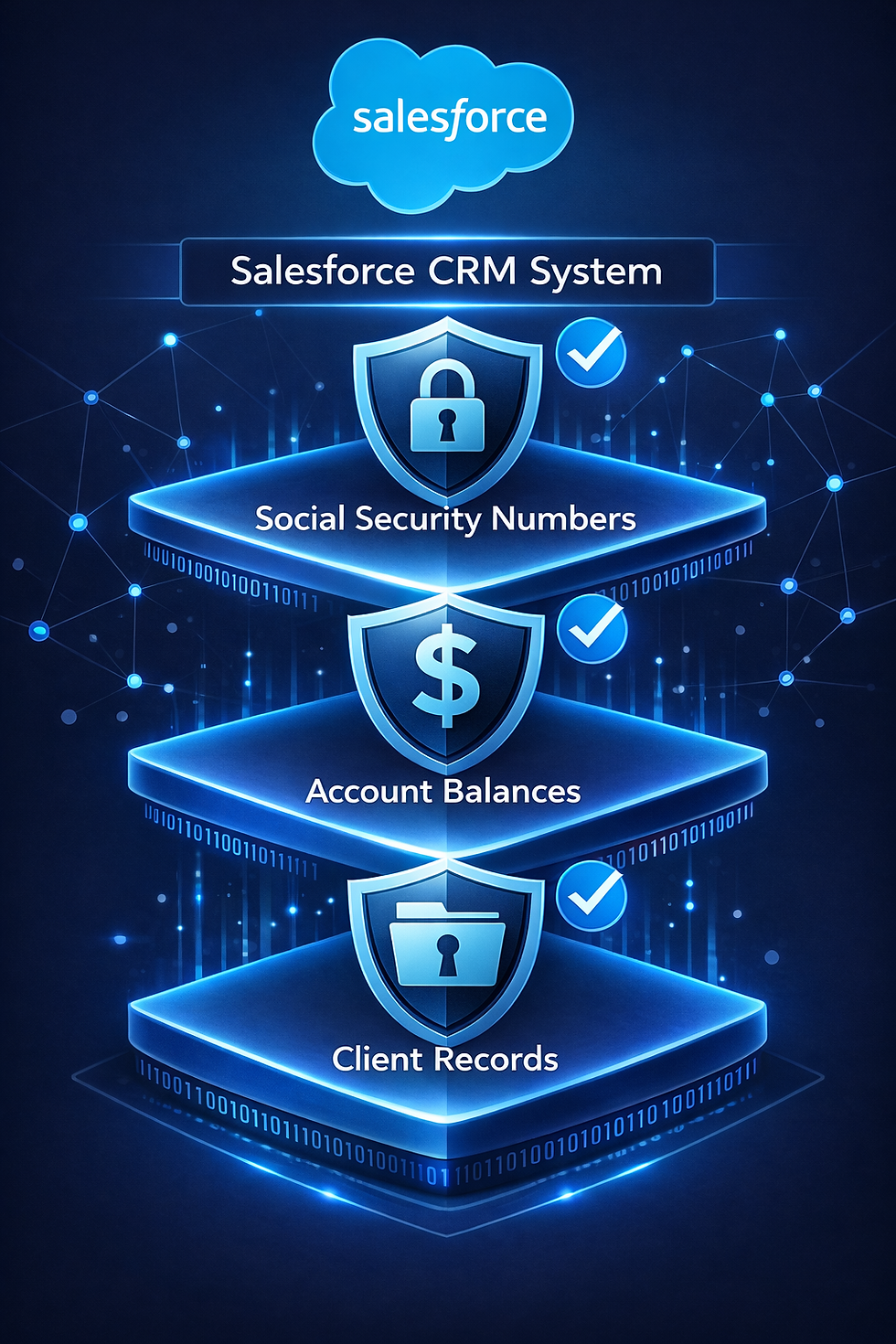
Salesforce implementations for financial firms often involve sensitive client data: Social Security numbers, account balances, transaction histories, beneficiary designations and so on. How that data is structured, who has access to it, and how it’s protected in the CRM are compliance matters—not just technical preferences.
Licensed Salesforce partners with financial services experience understand how to configure Salesforce’s permission sets, field-level security, and sharing rules to meet regulatory standards. Unlicensed vendors may implement technically functional solutions that create compliance gaps—gaps that may not be visible until a regulator asks questions or a data incident occurs.
Audit Trails and Record-Keeping
Financial firms have strict record-keeping obligations. Salesforce’s Field History Tracking and Event Monitoring features can support compliance—but only if they’re properly configured. An experienced licensed partner knows which objects and fields require tracking, how long data must be retained, and how to make records accessible for audit purposes. Vendors without this background may not know what they don’t know.
Financial Services Cloud Expertise
Salesforce offers Financial Services Cloud (FSC)—a purpose-built product for wealth management, banking, and insurance firms. FSC includes features like household financial account management, referral tracking, and compliance-ready relationship management tools that are specifically designed for regulated environments.
Implementing FSC correctly requires specialized knowledge that goes beyond general Salesforce expertise. Licensed partners who specialize in financial services will have FSC-specific certifications and hands-on implementation experience. Vendors without this background may attempt to replicate FSC functionality through workarounds—creating fragile configurations that are harder to maintain and more likely to introduce compliance issues.
What Unlicensed Vendors Often Don’t Tell You
Unlicensed vendors typically compete on price. And in the short term, their proposals often look attractive. Here’s what frequently gets left out of those conversations.
No Direct Salesforce Support Escalation
Licensed Salesforce partners have access to dedicated partner support channels. When a complex issue arises during implementation—a data migration problem, an unexpected platform behavior, an integration that won’t connect—licensed partners can escalate directly to Salesforce engineering resources. Unlicensed vendors cannot. They’re working through the same public support channels as end users, which means longer resolution times and limited access to platform-level fixes. For financial firms, where downtime and data integrity issues can have real operational consequences, this matters.
No Access to Partner-Exclusive Resources
Salesforce provides licensed partners with early access to product roadmaps, beta features, technical enablement, and sales and implementation playbooks. This means licensed partners can advise clients on platform direction—helping firms make architectural decisions that will age well rather than requiring expensive rework when Salesforce releases new features or deprecates old ones.
Liability and Recourse Gaps
When something goes wrong in an implementation—and in complex projects, something almost always requires course-correction—licensed partners operate within a framework that includes Salesforce’s partner code of conduct and customer success expectations. If a licensed partner delivers a failed implementation, there are formal channels for escalation to Salesforce.
With an unlicensed vendor, your recourse is whatever is in your contract—and nothing more. If the vendor is unresponsive, closes, or disputes responsibility, you’re left holding an incomplete implementation with no platform-level avenue for resolution.
The Hidden Rework Cost
We’ve seen financial firms come to us after unlicensed vendor implementations with systems that technically function but require significant rework to meet compliance requirements or operate at scale. The original implementation was cheaper. The total cost—original project plus rework plus the compliance exposure during the interim—was considerably higher.
A Common Scenario A regional RIA firm engaged an unlicensed vendor to implement Salesforce for client relationship management. The implementation was delivered on time and under budget. Eighteen months later, a routine internal audit revealed that field-level security had been misconfigured—allowing staff across the firm to view sensitive client financial data they had no business need to access. The remediation required both technical rework and a compliance review process. The original savings evaporated quickly. |
A Balanced Perspective: When Unlicensed Vendors Might Be Acceptable
Vendor-neutral guidance means being honest about the nuances, not just making the case for one answer. There are scenarios where unlicensed vendors may be a reasonable choice:
Simple, low-risk implementations: If a firm needs basic Salesforce setup—a sales pipeline for a non-regulated business unit, simple contact management without sensitive data—the compliance stakes are lower.
Supplemental development resources: For specific, well-defined technical tasks—building a custom report, creating an automation—an unlicensed developer with strong individual certifications may be appropriate when overseen by an internal Salesforce admin or a licensed consulting partner.
Hybrid models: Some firms engage a licensed partner for architecture and compliance-sensitive configuration, then use lower-cost resources for volume development work under proper oversight.
What’s rarely appropriate for financial firms is using unlicensed vendors for end-to-end implementation of systems that touch regulated data, client-facing workflows, or compliance-sensitive processes. The risk-to-savings ratio simply doesn’t hold up under scrutiny.
A Balanced Perspective: When Unlicensed Vendors Might Be Acceptable
Vendor-neutral guidance means being honest about the nuances, not just making the case for one answer. Here are a few scenarios where unlicensed vendors may be a reasonable choice:
Simple, low-risk implementations: If a firm needs basic Salesforce setup—a sales pipeline for a non-regulated business unit, simple contact management without sensitive data—the compliance stakes are lower.
Supplemental development resources: For specific, well-defined technical tasks—building a custom report, creating an automation—an unlicensed developer with strong individual certifications may be appropriate when overseen by an internal Salesforce admin or a licensed consulting partner.
Hybrid models: Some firms engage a licensed partner for architecture and compliance-sensitive configuration, then use lower-cost resources for volume development work under proper oversight.
It's rarely appropriate for financial firms to use unlicensed vendors for end-to-end implementation of systems that touch regulated data, client-facing workflows, or compliance-sensitive processes—the risk-to-savings ratio simply doesn’t hold up under scrutiny.
The True Cost of Vendor Selection
Selecting a Salesforce implementation vendor feels like a procurement decision. It’s actually a strategic one. A well-implemented Salesforce environment becomes the operational backbone of a financial firm’s client relationships, compliance workflows, and business development activities. The vendor who builds that foundation shapes how the system will function for years—and how easily it can be extended, audited, and adapted as regulations and business needs evolve.
Licensed partners with genuine financial services expertise cost more upfront. They charge appropriately for specialized knowledge and accountability. But for regulated firms managing sensitive client data, the alternative—an unlicensed vendor who builds something cheaper and faster but misses the compliance implications—creates a liability that can dwarf the original savings.
The math usually becomes clear when decision-makers consider not just implementation cost, but total cost: initial project plus likely rework, plus compliance remediation risk, plus the cost of limited vendor accountability if something goes wrong.
Actionable Next Steps
If your firm is currently evaluating Salesforce vendors or reconsidering an existing vendor relationship, here’s a practical starting point:
Verify partner status immediately using Salesforce’s public partner directory for any vendor you’re actively considering.
Request a compliance-focused scope conversation with finalists. Vendors who have genuine financial services experience will welcome this discussion. Those without it will struggle to engage substantively.
If you’ve already implemented with an unlicensed vendor, consider a compliance review of your current configuration before your next audit cycle or system expansion.
Engage your compliance team early in vendor selection. Their input on data handling requirements and audit trail needs will sharpen your evaluation questions.
Don’t let price be the primary driver. Frame the decision around total cost of ownership and risk-adjusted value—a framework your compliance officers and leadership team will recognize as appropriate for regulated operations.
Partner with Ohana Focus

Licensed Salesforce Financial Services Cloud vendors and integration partners.
Ohana Focus is a certified Salesforce consulting partner with deep experience in financial services implementations. We understand the compliance requirements, data sensitivity, and operational complexity that regulated firms bring to Salesforce projects—and we build systems that work for your business and hold up to regulatory scrutiny.
Whether you’re evaluating vendors for a new implementation, assessing an existing system’s compliance posture, or exploring Financial Services Cloud, we bring honest guidance and proven expertise to the conversation. We bring:
Certified Salesforce partnership with financial services specialization
Financial Services Cloud implementation expertise
Compliance-informed configuration and data architecture
Honest assessment of your current environment’s strengths and gaps
Ongoing support for growing and evolving regulatory requirements
About Ohana Focus
Ohana Focus is a certified Salesforce consulting partner dedicated to helping financial services firms and nonprofits harness the full power of their data. We believe great Salesforce implementations aren’t just technically sound—they’re built to support the compliance, operational, and strategic realities of the organizations we serve. Our team brings certified expertise, industry-specific experience, and a commitment to honest guidance to every engagement.


Comments