What Makes a Great Salesforce Financial Cloud Migration Partner? 10 Questions to Ask
- Ohana Focus Team

- Feb 23
- 9 min read

Migrating to Salesforce Financial Cloud is one of the most consequential technology decisions a financial services organization will make. Done well, it transforms how your team manages client relationships, tracks compliance activity, and drives revenue growth. Done poorly, it creates years of technical debt, frustrated advisors, and data problems that are expensive to untangle.
The difference between those two outcomes often comes down to a single factor: the partner you choose to guide the migration. The market is full of Salesforce implementation partners. Some specialize in financial services, others have deep nonprofit or healthcare backgrounds and are expanding into fintech. Some are large consultancies where your project gets handed to a junior team after the sales meeting, and knowing how to separate the right partner from the rest requires asking the right questions before you sign anything.
Why Partner Selection Is So Critical for Financial Cloud Migrations

Salesforce Financial Cloud is purpose-built for financial services: wealth management, banking, insurance, and lending. It carries native features for client households, financial accounts, referral management, action plans, and compliance documentation. But that specialization cuts both ways.
A partner who truly understands Financial Cloud will configure it to take full advantage of its industry-specific data model. A partner who knows Salesforce broadly but lacks Financial Cloud depth will often over-customize, building workarounds for problems that Financial Cloud already solves natively. That approach results in higher costs, more maintenance overhead, and a system that’s harder to upgrade when Salesforce releases new features.
Financial services also carry compliance stakes that other industries don’t. Data handling, audit trails, regulatory documentation, and privacy requirements aren’t afterthoughts—they’re core to how the system must be built. A partner who treats these as checkboxes rather than foundations creates real organizational risk.
With those stakes in mind, here are the ten questions that separate excellent migration partners from the rest:
1. How Many Salesforce Financial Cloud Migrations Have You Completed?
This seems obvious, but the answers are often surprising. Many partners who advertise Financial Cloud services have completed only a handful of actual Financial Cloud implementations or have broader Salesforce experience that they’re applying to Financial Cloud for the first time. You're looking for specific numbers, not generalities: “We’ve done dozens of Financial Cloud projects across wealth management and banking” is a different answer than “We have extensive Salesforce experience that translates well to financial services.” The first is reassuring; the second is a polished redirect.
Follow-up question: “Can you share a reference from a client of similar size and complexity in our specific segment?” A confident partner will have references ready. A partner who stalls or pivots deserves scrutiny.
2. What Is Your Approach to Data Migration and Data Quality?
Data migration is where most Financial Cloud implementations run into trouble. Legacy CRM systems often have years of inconsistent data entry, duplicate records, incomplete account structures, and fields that don’t map cleanly to Salesforce’s Financial Cloud data model. How a partner handles this complexity is one of the clearest indicators of their overall quality.
Demand a structured, phased approach to data assessment, cleansing, mapping, and validation. The best partners run a data audit before writing a single line of migration code. They document field-mapping decisions, flag data-quality issues for your team to resolve, and build validation checks to confirm that migrated data accurately matches the source.
Be cautious of partners who minimize the complexity of data migration, promise it will be fast, or plan to migrate everything first and “clean it up afterward.” That approach moves your mess from one system to another—and cleaning messy data inside Salesforce is significantly harder than cleaning it before migration.
3. How Does Your Team Handle Compliance and Regulatory Requirements?
Financial services organizations operate under regulatory frameworks that have direct implications for how a CRM must be configured. Depending on your segment, this might include FINRA recordkeeping requirements, SEC regulations, state-specific insurance licensing rules, banking privacy standards, or fiduciary documentation obligations.
As for real examples demonstrating that the partner understands compliance not as an add-on but as a design principle. They should be asking you about your regulatory environment early in scoping conversations, not late in the project. The best partners have worked directly with compliance officers and legal teams, understand audit trail requirements, and know how to configure Salesforce’s built-in compliance features (Shield, field audit trail, event monitoring) appropriately.
A partner who gives vague answers about compliance, or who suggests you loop in your legal team “later in the project,” is signaling that regulatory requirements aren’t built into their delivery approach.
4. Who Specifically Will Be Working on Our Project?
This is a question that organizations often forget to ask—until they’re three months into a project and realize that the senior consultants who impressed them during the sales process have been replaced by a less experienced team.
What you’re listening for: specific names and rôles, plus a clear commitment about who will remain on your project from discovery through go-live. Ask to meet the project manager and lead architect before signing. Ask what percentage of their time will be dedicated to your engagement. Ask what happens to staffing if one of the key team members takes another role or leaves the firm. Consistency matters enormously in CRM migrations. Every time a key team member is swapped out, there’s a knowledge transfer cost that your organization absorbs—in time, budget, and quality.
5. Describe Your Discovery Process
The discovery phase is where good migrations are won or lost. A thorough discovery process surfaces your business requirements, documents your current workflows, identifies data complexity, reveals integration points, and flags risks before they become expensive problems mid-project.
A potential partner should have a structured, multi-week discovery process that involves not just your IT team but also the people who actually use the system daily—advisors, relationship managers, operations staff, compliance officers, etc. The best partners treat discovery as an investment, not a formality. They ask hard questions. They push back on assumptions. They come to the table with frameworks and tools, not just blank notebooks.
Be cautious of partners who want to move quickly from contract signing to development. Speed in the early phases almost always means problems in the later ones.
6. How Do You Handle System Integrations?
Financial services organizations rarely run Salesforce in isolation. Your CRM typically needs to integrate with portfolio management systems, financial planning software, document management platforms, email archiving tools, marketing automation, and possibly core banking or insurance policy administration systems. The integration landscape is often the most technically complex part of any Financial Cloud implementation.
You want specific experience with the systems you actually use, not just general integration methodology. Ask whether they’ve connected Salesforce to your specific portfolio management system or your document vault. Ask whether they use Salesforce’s native integration capabilities where appropriate, or whether they default to custom middleware that requires ongoing maintenance.
Integration quality problems are among the most common sources of post-migration frustration. Data that doesn’t sync properly, duplicate records created by integration errors, and broken workflows between systems can undermine user adoption quickly.
7. What Is Your Approach to User Training and Adoption?
It's far more likely that a migration will fail due to adoption problems, not technical problems. A beautifully configured Salesforce environment delivers zero value if your advisors and relationship managers revert to spreadsheets, email inboxes, and sticky notes after go-live.
What you’re listening for: a change management and training strategy that goes beyond a one-day training session before go-live. The best partners build adoption into the project from the beginning—involving end users in design decisions, running user acceptance testing with actual staff, creating role-specific training materials, and planning for ongoing reinforcement after the system launches.
Ask specifically how they handle resistant users—the advisors who are most skeptical of the new system. A partner with real adoption experience will have practical, honest answers about how to work through that resistance. A partner focused purely on technical delivery may not have thought about it seriously.
8. How Do You Scope and Manage Project Changes?
Scope creep is one of the most common reasons CRM migrations go over budget and over deadline. As projects progress, new requirements emerge, stakeholders request enhancements, and the original statement of work starts to look inadequate. How a partner handles these situations tells you a great deal about how the overall engagement will feel.
A good partner should have a transparent, structured change management process and a clear mechanism for documenting scope changes, pricing them fairly, and getting explicit approval before proceeding. They communicate proactively when a request would trigger a change order, rather than surprising you with additional costs after the work is done.
Also ask: “How do you handle it when your team realizes mid-project that something was scoped incorrectly?” The answer reveals how accountable the partner is when mistakes happen on their side of the table.
9. What Support Do You Provide After Go-Live?
Go-live is not the end of the project—it’s the beginning of the most critical phase. The first 30 to 90 days after launch are when user adoption either takes hold or falters, when data quality issues surface in real workflows, and when the configuration decisions made during development get tested by actual daily use.
You need a well-defined post-go-live support plan with clear response time commitments, named contacts, and an explicit transition process if ongoing managed services will transfer to a different team. Ask whether the project team stays involved during the hypercare period or whether support immediately transitions to a separate help desk.
Be sure to ask about ongoing optimization. The best Salesforce implementations aren’t static—they evolve as your business does and as Salesforce releases new features. A strong partner thinks about a long-term relationship, not just a project handoff.
10. What Would You Do Differently If You Were Us?
This is the question most organizations never think to ask—and it’s often the most revealing. A great migration partner is not just a vendor who executes your requirements. They’re a strategic advisor who brings a unique perspective your team may not have.
Listen for an honest, specific, experience-backed perspective. A strong partner might say: “Organizations of your size often try to migrate too much data at once—we’d recommend a phased approach starting with active clients.” Or: “The integration your current vendor is proposing will cause duplicate records; here’s a better architecture.” Or: “Your timeline is aggressive for this scope—here’s what we’d prioritize to hit your go-live date without cutting corners that matter.”
A partner who just agrees with everything you’ve planned is either telling you what you want to hear or doesn’t know enough to push back. Neither is a good sign.
Red Flags to Watch For During Partner Conversations
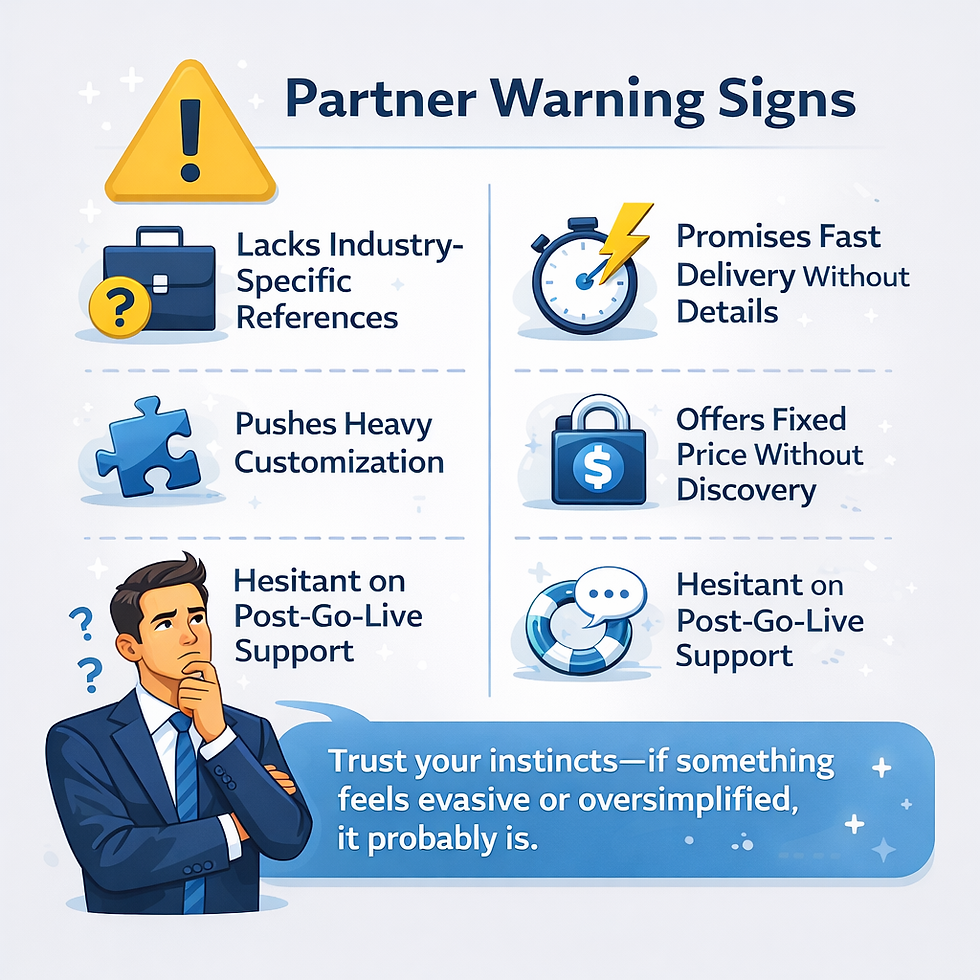
Even with strong questions, some warning signs are worth naming directly. Be cautious when a partner cannot produce specific Financial Cloud references from your industry segment, promises an unusually short timeline without detailed justification, proposes heavy customization for problems Financial Cloud already solves out of the box, provides a fixed-price proposal without a thorough discovery phase, or is reluctant to discuss post-go-live support commitments in writing.
None of these factors is automatically disqualifying on its own, but each one warrants a direct follow-up conversation. Your instinct during the evaluation process is worth trusting—if something feels evasive or oversimplified, it probably is.
A Note on Honest Tradeoffs
No partner is perfect for every organization. Larger consulting firms bring deep bench strength and breadth of capability, but your project may get deprioritized against bigger clients. Boutique specialists often provide more senior attention and industry depth, but may have limited capacity for very large engagements. Cost structures vary widely—and the cheapest proposal rarely reflects the true cost of the engagement once change orders are factored in.
The right partner for your organization depends on your size, complexity, timeline, internal technical capacity, and how much strategic guidance versus pure execution you need. Be honest with yourself about those factors, and use the questions above to probe whether the partners you’re evaluating are genuinely suited to your situation—not just motivated to win the contract.
Actionable Next Steps for Your Partner Evaluation
Begin your evaluation process by preparing an internal summary of your situation before reaching out to any partner. Document your current system, approximate data volumes, key integration points, your go-live goal, your internal technical capacity, and your top two or three business outcomes for the migration. Sharing this context upfront will immediately reveal which partners engage thoughtfully versus which ones recite their standard pitch regardless of your specifics.
After that, run all partner conversations through the ten questions in this guide. Score each partner honestly on the quality of their answers—not just their confidence. The best partners will welcome the rigor. They’ve answered hard questions before, and they’re comfortable being held accountable.
Finally, talk to references. Not the references the partner hand-picks for you—those will always be positive. Ask the partner for their last three Financial Cloud clients in your segment, then ask those clients what surprised them about the engagement, what they would do differently, and whether they’d work with the partner again.
Partner with Ohana Focus

Expert Financial Services Cloud implementation and integration. Schedule your free consultation today.
If you’re preparing for a Salesforce Financial Cloud migration—or evaluating whether Financial Cloud is the right move for your organization—Ohana Focus is ready to have an honest conversation with you. We specialize in Financial Cloud implementations for financial services organizations. That means we understand your regulatory environment, your client data structure, your advisor workflows, and the integration ecosystem your team depends on. We’ve delivered Financial Cloud projects across wealth management, banking, and insurance—and we bring that specific experience to every engagement.
At Ohana Focus, we start with a rigorous discovery process that involves the people who actually use your current system. We design for compliance from the first whiteboard session, not the last. We staff projects with senior consultants who stay through go-live. And we build post-migration relationships, not just post-migration handoffs. Our skills include:
Deep Financial Cloud expertise across wealth management, banking, and insurance
Compliance-first architecture that protects your organization from regulatory risk
Structured data migration methodology that addresses quality before migration, not after
Senior-staffed engagements with consistent team members from discovery through go-live
Transparent change management processes and honest project communication
Post-go-live support and ongoing optimization partnerships
About Ohana Focus
Ohana Focus is a certified Salesforce consulting partner dedicated to helping financial services organizations harness the full power of Salesforce Financial Cloud. We believe a great CRM implementation isn’t measured by go-live—it’s measured by how confidently your team uses the system six months later, and the business outcomes that follow. Our Financial Cloud practice has helped organizations across the advisory, banking, and insurance segments migrate successfully, build compliant data architectures, and create systems their teams actually want to use.



Comments