From Renewal Reminders to Proactive Customer Retention: How Salesforce Changes the Renewal Conversation
- Ohana Focus Team

- Mar 3
- 9 min read

Ask any insurance account manager to describe their renewal process, and the answer usually sounds pretty generic: 90 days out, a reminder surfaces. Someone calls or emails the client. If there's no response, a follow-up goes out. The policy renews, or it doesn't, and everyone moves on to the next one in the queue. It's organized, it's repeatable, and for most organizations, it has worked well enough for years.
The problem isn't that this process is broken. It's that it treats every renewal as essentially equivalent—the same trigger, the same outreach, the same conversation—regardless of what's actually happening in the client relationship. The longtime client who referred three friends last year gets the same 90-day reminder as the one who called twice to complain about their rate. The prospect who has been comparing quotes for months gets the same follow-up cadence as the client who hasn't thought about their coverage since they signed.
Salesforce doesn't just automate the reminder. Used well, it fundamentally changes what the renewal conversation is about—moving it from a transactional check-in to a genuinely informed touchpoint that reflects what you actually know about the client. Let's examine how that shift happens in practice and what it takes to build a retention strategy that goes beyond the calendar.
The Renewal Reminder Is Not a Retention Strategy
It's worth being direct about this because the two things are often conflated, which causes real problems. A renewal reminder is a logistics tool. It ensures the renewal doesn't fall through the cracks. That's valuable—policies lapsing because nobody remembered to make contact is a genuine failure mode—but it doesn't, by itself, retain clients.
Retention happens before the renewal conversation starts. It happens in the service interactions that went well or poorly over the past 12 months, whether the client feels understood or just processed and whether your team knew that the client's business had grown significantly and the coverage no longer fit, before the client discovered that gap on their own.
The organizations with the strongest retention rates aren't the ones with the most sophisticated reminder systems. They're the ones whose account managers arrive at renewal conversations already knowing what's changed, what matters to the client right now, and what the relationship looks like from the client's side of the table. That kind of preparation used to require either exceptional institutional memory or an account manager who had personally handled the relationship for years. Salesforce makes it possible at scale.
Customer Retention: What Salesforce Actually Enables

A Complete Picture of the Relationship Before the Call
When a Salesforce account is built and maintained correctly, an account manager preparing for a renewal call can see the full arc of the client relationship in a few minutes: every service interaction logged, every email sent, every claim filed, every time someone called with a question. They can see whether service issues were resolved quickly or dragged out. They can see if the client has opened and clicked renewal-related communications or ignored them entirely.
This is different from what most CRM systems provide, which is typically a contact record with some notes attached. The difference is completeness and accessibility—all of it in one place, updated in real time, filterable and sortable in ways that help you prepare for a specific conversation rather than just review a history.
A renewal call with an account manager who knows that the client filed two claims this year (both resolved to their satisfaction) and that they referred a colleague three months ago has a fundamentally different experience than one who only knows that the policy renews on the 15th.
Segmentation That Actually Drives Behavior
One of the most underused capabilities in Salesforce is the ability to segment your book of business in ways that go beyond policy type and premium size. With the right data structure, you can identify clients who have had three or more service contacts in the past 12 months—an early signal of dissatisfaction that rarely shows up in retention dashboards until it becomes a cancellation. You can identify clients whose coverage hasn't changed in five years while their business has grown significantly. You can find the clients who have referred others and have never been formally thanked or recognized for it.
Each of those segments calls for a different renewal conversation. The frustrated client needs acknowledgment and a genuine plan before you ask them to sign another year. The under-insured client needs an honest coverage conversation, even if it makes the renewal more complicated. The advocate client deserves recognition that goes beyond a boilerplate thank-you.
Building these segments in Salesforce takes initial investment—you need clean data, clear definitions, and someone who knows how to build the reports. But once built, they run automatically. Every renewal that falls into the 'multiple service contacts' segment flags itself. No account manager has to remember to check.
Automation That Supports the Human, Not Replaces It
There's a version of renewal automation that clients can feel immediately, and not in a good way. The email that arrives exactly 90 days before renewal has your name mail-merged in. The follow-up arrives 30 days later, regardless of whether you responded. The sense that you're moving through a conveyor belt that runs whether or not anyone is actually paying attention.
Salesforce automation, when built thoughtfully, does something different. It handles the administrative work—the reminders to the account manager, the documentation that the contact was made, the tracking of who has and hasn't been reached—so that the human interaction itself can be more focused. The account manager isn't spending time figuring out who to call today. They're spending that time actually preparing for the calls that matter most.
The automation serves the relationship. The relationship is still the point.
Building a Proactive Retention Workflow
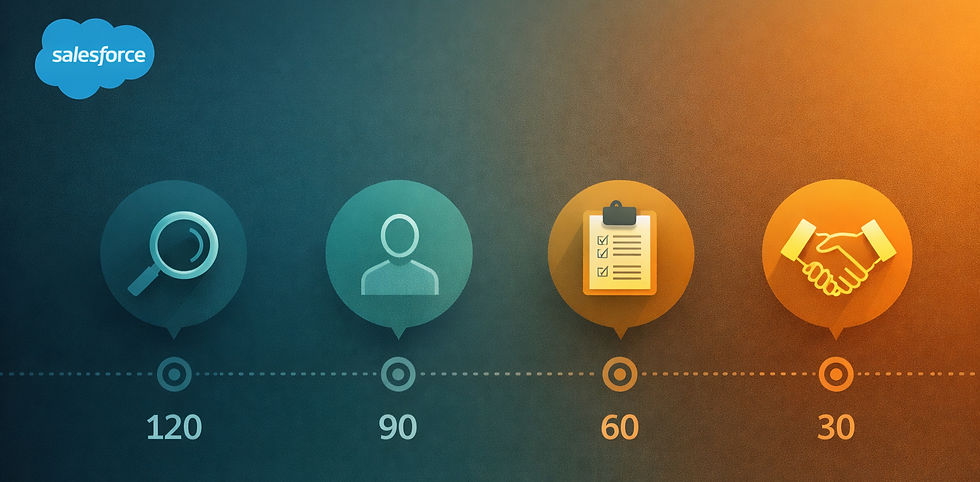
What does this actually look like when it's working? Here's a practical sequence that organizations using Salesforce well tend to converge on, regardless of their size or the specific lines they write.
120 Days Out: The Relationship Review
Before any client-facing contact happens, the account manager (or a team lead, for larger books) reviews the client's Salesforce record with retention in mind. Not just the policy details—the relationship health. Has service been smooth? Have there been complaints? Has anything happened in the client's life or business that's visible in the record?
This review is made practical by having the right Salesforce view set up: a renewal-prep layout that surfaces relationship health indicators alongside policy basics. Building this view takes a few hours of Salesforce configuration. The payoff is that preparation becomes systematic rather than dependent on individual account managers remembering to do it.
90 Days Out: Segmented Outreach, Not Mass Contact
The 90-day touchpoint is where most organizations treat all clients the same. With Salesforce, it's where differentiation begins. The clients flagged for relationship concerns get personal outreach from a senior account manager. The straightforward renewals may get a well-crafted email that actually reflects what you know about them. The long-tenured advocates get something that acknowledges the relationship.
None of this requires more staff time in total—it requires the time to be directed differently. Less time processing routine renewals that will almost certainly renew regardless, more time on the relationships that are genuinely at risk.
60 Days Out: The Coverage Conversation
For clients whose circumstances may have changed, the 60-day mark is when to have the coverage conversation—not as part of the renewal pitch, but as a genuine check-in. Has the business changed? Have there been life events that affect coverage needs? Is the existing policy still the right fit?
This conversation is only possible if you have something to bring to it. If the Salesforce record has been maintained, you may already know that the client's business added employees last year, or that they acquired a property that isn't on the current schedule. That knowledge transforms the conversation from 'would you like to review your coverage?' to 'I noticed your team has grown—let's make sure your coverage reflects where you are now.'
Clients who feel seen rather than processed renew. That's not a marketing insight—it's a relationship reality.
30 Days Out: The Close
With proactive work done in the preceding 90 days, the 30-day touchpoint should rarely involve surprises. The clients who were at risk have either been addressed or have indicated they're leaving—and in either case, you know why, which is information that improves future retention. The straightforward renewals close efficiently.
The difference between this and a standard 30-day reminder isn't complexity—it's the preparation that happened before it. The reminder becomes a confirmation of a relationship that's already been tended, rather than the first real conversation of the renewal cycle.
What Makes This Work
This picture is accurate, but it would be misleading to present it without acknowledging what it requires. Salesforce doesn't automatically produce a proactive retention strategy. It provides the infrastructure for one, which is meaningful, but it's not the same thing.
Clean, Consistently Maintained Data
A Salesforce record that hasn't been updated since the policy was bound tells you almost nothing useful about the current state of the relationship. The value of Salesforce for retention depends entirely on the discipline with which relationship data is captured and maintained. That means logging service interactions, not just formal communications. It means updating records when circumstances change. It means someone owning the data quality question and treating it as an operational priority, not an afterthought.
Organizations that struggle with retention-focused Salesforce use almost always have a data quality problem upstream. The fix is cultural as much as technical—it requires account managers to see record-keeping as part of the job, not separate from it.
Defined Segments and Criteria
The segmentation that makes proactive retention possible requires someone to make explicit decisions: what does a 'at-risk' client look like in your data? How many service contacts in what timeframe constitutes a signal worth acting on? What does 'advocate' mean operationally, not just conceptually?
These decisions are often harder than they appear, because they require organizations to surface assumptions that have been implicit for years. But making them explicit is what makes them actionable. A segment that's clearly defined can be built in Salesforce and maintained automatically. A vague sense that 'some clients seem less happy' can't.
Account Manager Buy-In
The most common failure mode for customer retention-focused Salesforce implementations isn't technical—it's adoption. Account managers who experience Salesforce as a reporting burden rather than a tool that helps them do their jobs better will log the minimum required information and no more. The result is a system that looks functional but doesn't actually support the relationship intelligence that makes proactive retention possible.
Getting this right means involving account managers in the design of the workflows, not just training them on the result. It means building Salesforce views that are genuinely useful in their daily work, not just useful to management for tracking purposes. The system should make their jobs easier. If it doesn't, the data quality problem is almost inevitable.
The Customer Retention Metrics That Actually Matter

Most organizations track renewal rate as the headline retention metric, and it's a reasonable starting point. But it's a lagging indicator—by the time it moves, the problem has already happened. Salesforce makes it practical to track the leading indicators that predict renewal outcomes before they're determined.
Client Sentiment Signals
The frequency and nature of service contacts are meaningful predictors of renewal risk. An account that has called with complaints three times this year is not equivalent to one that has been entirely quiet, even if both policies are renewing on the same date. Salesforce can make this visible.
Coverage Fit Over Time
How often are accounts actually reviewed and updated? A book of business where the average policy hasn't been touched in three years is a retention risk waiting to surface. Salesforce can track review frequency as an operational metric, not just an aspirational one.
Response Rate to Renewal Outreach
If clients aren't engaging with renewal communications, that's information. Salesforce can track open and response rates in ways that identify disengaged clients before they silently move to a competitor.
Cancellation Reasons
If cancellations aren't being logged with specific, consistent reason codes, organizations lose the ability to identify patterns. Was it the price? Service level agreements? A competitor's offer? Life change? Each answer points to a different operational response. Salesforce makes capturing and analyzing this data straightforward—if the organization commits to doing it consistently.
Moving From Where You Are to Where You Want to Be
The gap between a reminder-based renewal process and a proactive retention strategy isn't closed overnight. But it also doesn't require a complete system overhaul before any progress is possible. The organizations that make this transition most successfully tend to follow a similar path.
They start by improving data quality in the existing system before adding new workflows. A proactive retention strategy built on stale or incomplete data produces false confidence, not better outcomes. Getting the data right first is worth the time. They identify one or two high-value segments—usually the at-risk category and the advocate category—and build differentiated approaches for those before trying to customize for the entire book. Success in a limited scope builds the organizational confidence and muscle memory to expand.
They involve account managers early, asking them what information would actually help them prepare for renewal conversations, and building the Salesforce views around those answers. This is the difference between a system that gets used and one that gets worked around.
Ideally, this should be treated as an ongoing process rather than a project with a completion date. A proactive retention strategy improves as the data improves, as the segments get refined, and as account managers get more comfortable using the system to inform rather than just document.
Partner with Ohana Focus

Building a proactive retention strategy in Salesforce requires getting the data model right, designing workflows that account managers will actually use, and making the connection between relationship intelligence and renewal outcomes explicit and measurable.
Ohana Focus specializes in helping insurance organizations move beyond reminder-based renewal processes to retention strategies that reflect what they actually know about their clients. We understand both the Salesforce side and the practical realities of how insurance relationships work. Our services include:
Retention workflow design and Salesforce configuration
Data quality assessment and remediation planning
Segment development and reporting setup
Account manager training focused on practical daily use
Ongoing support as the strategy evolves
About Ohana Focus
Ohana Focus is a certified Salesforce consulting partner dedicated to helping organizations build stronger client relationships through better data. We believe retention isn't a technology problem—it's a relationship problem that technology can support. Our practice has helped insurance organizations across the country move from reactive renewal management to proactive retention strategies that reflect genuine client knowledge and produce measurable results.



Comments