Know Your Customer: How Informatica’s MDM + Agentforce Delivers a 360° View for Fintech CRM
- Ohana Focus Team

- Apr 20
- 11 min read

For many fintech companies, the customer data problem is hidden in plain sight. The compliance team has one version of a customer’s identity, the lending platform holds another, and the fraud detection engine tracks yet a third. When a high-value prospect calls in, your relationship manager scrambles across five systems trying to assemble a coherent picture—and still walks into the conversation half-blind. The result is what the industry politely calls “data fragmentation" — lost revenue, compliance risk, frustrated customers, and relationship managers operating without the context they need to do their jobs well.
Informatica’s Master Data Management (MDM) platform, integrated with Salesforce’s Agentforce and its native CRM capabilities, represents a genuine solution to this problem—not a workaround, not a data warehouse band-aid, but a fundamentally different architecture for how fintech companies know their customers. Once experienced, returning to siloed data feels like navigating a trading floor with yesterday’s newspaper.
The Fragmented Customer Problem
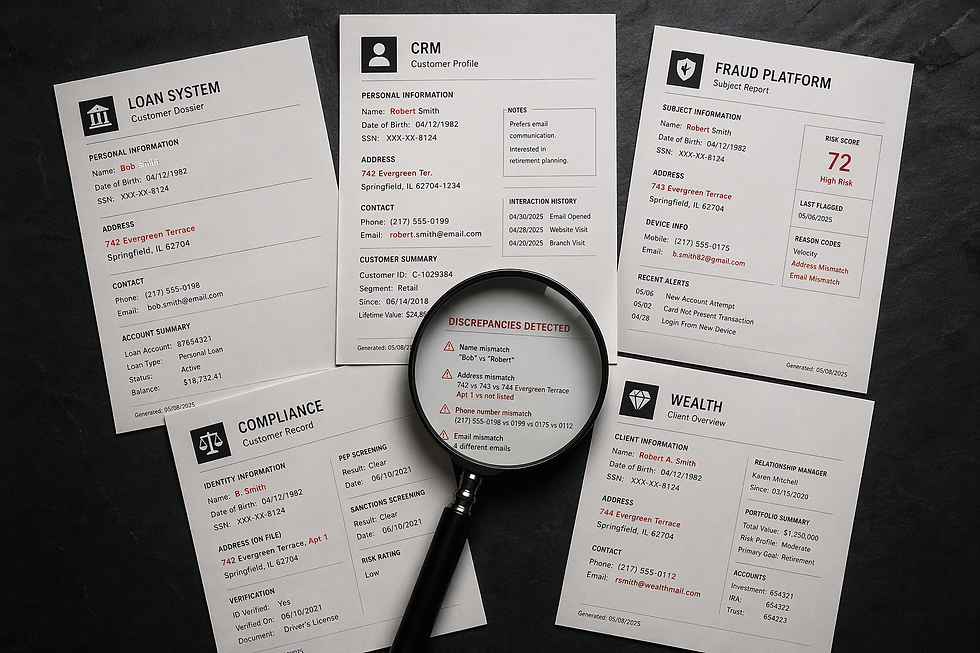
There is nothing uniquely negligent about how most fintech companies arrived at their data fragmentation problem. It happened organically, through years of product launches, acquisitions, regulatory-driven system builds, and the natural sprawl of a fast-scaling business.
Consider a mid-sized digital bank operating a checking product, a personal loan product, and a recently acquired wealth management arm. Here’s what “knowing the customer” actually looks like in practice:
A relationship manager wants to identify customers holding checking accounts who also qualify for a wealth management conversation. The CRM query runs. Then the loan origination system gets checked. Then the wealth management platform gets accessed separately. Customer names get cross-referenced manually. Duplicates surface because one system uses “Robert” and another uses “Bob.” The compliance hold that should have flagged this account three weeks ago never made it across systems.
An hour later, the relationship manager has a list—but no confidence in its accuracy.
This is the fragmented customer problem. It persists not because fintech teams are careless, but because most data infrastructure was built system-by-system, not customer-first. Informatica MDM flips that architecture entirely.
What Informatica MDM Actually Does

Master Data Management is a term that gets used loosely, so it’s worth being precise. Informatica MDM doesn’t replace your systems of record. It doesn’t require you to migrate off your loan origination platform or your core banking infrastructure. What it does is create a single, authoritative “golden record” for each customer. This continuously reconciled, deduplicated, enriched identity sits above all your source systems and serves as the truth layer. That golden record does several things that are impossible in fragmented environments:
Resolves identity across systems—“Bob Smith” and “Robert Smith” at the same address become a single record, with the full relationship lineage preserved.
Standardizes data hierarchies—household relationships, business ownership structures, and beneficial ownership chains are mapped and maintained.
Propagates changes bidirectionally—when a customer updates their address in one system, MDM ensures that change flows to all connected platforms.
Maintains a complete audit trail—every data change, merge, and enrichment is logged, which matters enormously for KYC and AML compliance.
Enriches records with third-party data—creditworthiness signals, firmographic data for business accounts, regulatory watchlist checks—all surfaced in one place.
The result is not a new database. It’s a living, intelligent data layer that makes every system connected to it smarter.
How Agentforce Changes Everything

MDM solves the data problem. Agentforce solves the access problem.
Having a perfect golden record in Informatica is only valuable if the people who need it can actually use it—in context, in the moment, without submitting a data request to an analyst. This is where Salesforce’s Agentforce platform becomes transformative for fintech CRM.
Agentforce is Salesforce’s AI-powered autonomous agent layer, built natively on the Einstein platform and designed to surface intelligent actions across the CRM. When connected to Informatica MDM as its data backbone, Agentforce becomes a relationship manager’s co-pilot that has read every note, seen every transaction, reconciled every data point across every product line—and can act on that context in real time.
A Real-World Scenario
It’s 8:47 AM. A high-net-worth client calls your private banking line. The relationship manager opens Salesforce. Here’s what Agentforce, powered by Informatica’s golden record, surfaces before the second ring:
Complete product relationship across all lines of business—checking, investment account, outstanding loan, and a business account held under a related LLC.
Last 90 days of meaningful interactions—service tickets, advisor touchpoints, and a recent large outbound wire that triggered a low-priority fraud review.
A proactive alert: the client’s investment account has been underperforming their stated risk tolerance for 60 days, and no advisor conversation has been logged.
A suggested next-best action: schedule a portfolio review and introduce the structured product launched last quarter—flagged as relevant based on the client’s stated goals.
Compliance context: KYC refresh is due in 45 days, and one document is outstanding.
None of this required a query, an export, or a pre-meeting data prep session. It was simply there—assembled from Informatica’s golden record, surfaced by Agentforce, displayed in the Salesforce interface the relationship manager already lives in.
The 360 Degree View in Fintech

In CRM marketing, the phrase “360° customer view” has become overused. Every platform claims to offer it; most deliver a slightly better-than-nothing aggregation of whatever data happens to be in their own system.
The Informatica + Agentforce integration delivers something materially different because it operates at the data infrastructure level, not the interface level. The 360° view is not a tab in your CRM that shows data from one platform. It’s a reconciled truth layer that every downstream system—including your CRM, your risk platform, your compliance engine, and your customer-facing channels—draws from. In practical terms, this means:
Your fraud team and your relationship manager are looking at the same customer record—not separate copies that diverged months ago.
A KYC update completed in your compliance system is immediately reflected in Salesforce without manual intervention.
Household and business relationship mapping—who is connected to whom across accounts—is maintained automatically and accessible in the CRM view.
Agentforce can reason across the complete relationship, not just the slice visible in one system.
This is the difference between a dashboard that aggregates data and a platform that unifies it.
Compliance as a Feature, Not a Burden

For fintech companies operating in regulated markets, data fragmentation isn’t just an operational inconvenience—it’s a regulatory liability. Know Your Customer obligations, Anti-Money Laundering requirements, and GDPR’s right-to-erasure provisions all assume that you actually know where your customer data lives and can produce or delete it on demand.
In fragmented environments, the honest answer to “Where does this customer’s data live?” is: “We’re not entirely sure.” That’s not an acceptable answer.
Informatica MDM transforms compliance from reactive scrambling to a built-in architecture. Because every record change is logged with full lineage, because identity resolution creates a single accountable record, and because data propagation is governed rather than ad hoc, compliance teams gain:
A complete, auditable history of every customer data change across all connected systems.
The ability to honor data deletion requests with confidence that all instances are captured.
Automated watchlist screening that updates across the full customer relationship, not just in the originating system.
Consistent KYC status visibility in Salesforce, without manual reconciliation between compliance platforms and CRM.
Relationship mapping that surfaces beneficial ownership structures for enhanced due diligence.
When Agentforce surfaces compliance context directly in the relationship manager’s workflow—“KYC refresh due in 45 days” appearing alongside the customer’s portfolio summary—compliance stops being a back-office concern and becomes part of the relationship management process itself.
What the “What If” Questions Look Like Now

In fragmented data environments, answering “what if” questions about your customer base requires an analyst, a data pull, and usually two to three days of lead time.
With Informatica MDM feeding Agentforce inside Salesforce, those questions become conversations.
Want to identify customers holding loans who haven’t been contacted in 90 days and whose credit profiles have improved since origination? Click. Want to see which households have multiple products but no active advisory relationship? Click. Want to filter your high-net-worth segment by geographic region and last interaction date? Click. The underlying data doesn’t change. The relationships don’t change. Users are simply viewing them through different lenses—iterating on the question until insight emerges, without rebuilding the query from scratch each time.
This is where Agentforce’s AI layer compounds the value. It doesn’t just retrieve data—it recommends actions. It surfaces the customers worth calling this week based on life events, account signals, and timing. It drafts the outreach. It logs the follow-up. It closes the loop between insight and action without requiring a human to manually translate between the two.
Democratizing Customer Intelligence Across the Organization

In most fintech organizations, deep customer intelligence is locked up with a small number of people—the data team who know how to query the warehouse, the senior relationship managers who’ve spent years building mental models of their books. Everyone else is working from summaries, gut instincts, or last quarter’s report.
This creates real organizational costs. Junior relationship managers underperform because they lack context. Cross-sell opportunities go unrecognized by product teams who can’t see the full customer relationship. Customer service agents escalate calls they could have resolved if they’d seen the account history. The Informatica + Agentforce integration changes this dynamic because it puts governed, accurate, complete customer intelligence directly in the Salesforce interface—the one your entire commercial team already uses.
Different Views for Different Roles
The beauty of the architecture is that different roles see the same underlying data through lenses built for their work:
The Chief Revenue Officer’s View: Pipeline health by product line, customer lifetime value distribution, cross-sell penetration rates, retention trends across segments.
The Relationship Manager’s View: Full household and business relationship map, recent interactions across all channels, next-best-action recommendations, compliance reminders, portfolio concentration analysis.
The Product Manager’s View: Customer segmentation by product usage, behavioral cohorts, feature adoption signals, and churn risk indicators.
The Compliance Officer’s View: KYC completion status across the portfolio, upcoming refresh deadlines, watchlist match alerts, data lineage and audit logs.
The Customer Service Agent’s View: Complete account relationship at a glance, recent service history, open cases, proactive context about why this customer might be calling today.
Everyone is working from the same truth. No one is working from the wrong version.
The Integration Reality: What to Expect

A reasonable concern surfaces at this point: “This sounds powerful, but our data environment is complex. We have legacy systems, custom integrations, years of data quality debt. Is this actually achievable?”
The honest answer is: yes, but it requires a disciplined approach. Here’s what the integration reality looks like for fintech companies at different starting points:
The Data Quality Investment
MDM is not a data quality fix—it’s a data quality multiplier. Organizations that feed poor data into Informatica get a well-organized golden record of poor data. The most important pre-integration work is not technical configuration; it’s profiling your source data, understanding where the quality problems live, and establishing data governance policies that will maintain quality over time.
The Phased Approach
The most successful implementations start with a defined scope—one product line, one customer segment, one use case—and demonstrate value before expanding. Connecting the MDM golden record to Salesforce for the wealth management book of business, for example, delivers measurable outcomes in relationship manager productivity and cross-sell conversion that build organizational confidence for the broader rollout.
The Change Management Reality
The technology integration is the tractable part. The harder work is shifting how teams think about customer data—from “my system’s view” to “the organization’s view.” Relationship managers who have spent years building context in their heads will initially resist trusting a system. Product teams accustomed to owning their customer segment data will push back on centralization. These are cultural shifts, and they require deliberate change management alongside technical delivery.
Breakthrough Moments After Integration

Fintech teams consistently experience several defining moments after the Informatica MDM + Agentforce integration goes live:
The Duplicate Shock: Most organizations discover, upon running their first identity resolution pass, that between 8–15% of their “unique” customers are duplicates. The immediate data quality win—and the compliance risk reduction—is often enough to justify the entire investment.
The Cross-Sell Moment: A relationship manager sees, for the first time on one screen, that a long-standing business loan customer has three employees with personal checking accounts—and none of them have been approached about the premium account tier. The pipeline gets built in minutes.
The Compliance Save: An enhanced due diligence flag raised in the compliance platform surfaces in Salesforce before a relationship manager initiates a significant transaction request. A potential regulatory issue is avoided because the data got to the right person in time.
The Departed Customer Recovery: Agentforce identifies a high-value customer who reduced product holdings 90 days ago, has had no outreach, and whose profile matches a recently launched product. The automated win-back sequence initiates. The customer returns.
The Real-Time Campaign Pivot: A targeted campaign targeting a specific customer segment updates in real time as Informatica’s enrichment layer identifies new qualifying customers. The campaign grows itself.
Making the Mental Shift

The hardest part of this transformation isn’t technical. It’s conceptual.
In the old paradigm, customer data was something your systems held in isolation—each platform its own version of the truth, each team working from their own slice. Knowledge about a customer lived in people’s heads because the systems couldn’t be trusted to agree.
In the new paradigm, customer data is a governed organizational asset—one version of the truth, accessible to every team through the lens appropriate to their work. Knowledge about a customer is institutional, not personal. Decisions are made from data because the data can be trusted.
This shift takes time. For months after go-live, teams will maintain their own spreadsheet trackers “just in case.” Relationship managers will double-check the system against their memory. Product teams will run parallel analyses.
This is normal. Give it time. But gradually, as the system proves itself—as the golden record saves a compliance issue, surfaces a cross-sell, catches a duplicate—the old habits fade. Not through mandate, but through trust earned.
What This Means for Your Organization

The organizational benefits extend well beyond better-looking customer profiles:
Faster revenue: When relationship managers spend less time assembling context and more time acting on it, conversion cycles compress. Deals close faster because managers show up prepared.
Lower compliance cost: Automated KYC refresh tracking, consistent identity across systems, and complete audit trails reduce the manual labor of compliance preparation and the risk of regulatory findings.
Better customer experience: Customers stop being asked to repeat themselves across channels. Service agents have context. Relationship managers make relevant recommendations. The organization’s competence becomes visible.
Reduced data debt: MDM’s identity resolution and quality governance prevent the accumulation of new data problems while systematically resolving existing ones.
Institutional intelligence: When a senior relationship manager leaves, their knowledge of the customer base doesn’t leave with them. It lives in the system.
Moving Forward

For fintech companies evaluating this integration, or those recently deployed and still building confidence in the platform, the path forward is consistent with how the best transformations always begin: start with a problem you already know is painful. Pick the relationship manager team that wastes the most time assembling pre-meeting context, the compliance workflow that requires the most manual reconciliation, or the cross-sell motion that’s been stalled by the inability to identify the right customers. Build the Informatica-to-Salesforce golden record for that use case. Connect Agentforce to surface the insight. Measure what changes.
That first success builds the organizational confidence for everything that follows. Questions start arriving: “Can we extend this to the business banking segment?” “What about connecting the fraud platform?” “Could Agentforce handle the initial customer onboarding conversation?”
The fragmented data habit fades—not through force, but because teams discover that working from a single source of truth is simply superior to working from five incompatible ones. Remember, this isn’t just a CRM upgrade. This is changing how your organization knows its customers.
Partner with Ohana Focus

Transform your fintech CRM with a customer data architecture that actually works.
Ohana Focus specializes in helping fintech companies design and implement Informatica MDM integrations with Salesforce and Agentforce—from golden record strategy and data governance design to Agentforce configuration and team enablement. We understand both the technical architecture and the commercial realities of financial services. We bring:
Informatica MDM implementation and optimization
Salesforce + Agentforce configuration for financial services
Data governance framework design
Identity resolution and data quality remediation
Team training on customer intelligence workflows
Ongoing support for complex cross-system integrations\
About Ohana Focus
We are a certified Salesforce and Informatica consulting partner dedicated to helping financial services organizations turn fragmented customer data into a competitive advantage. We believe great CRM isn’t about the interface—it’s about the data foundation underneath it. Our practice has helped fintech companies across lending, banking, and wealth management build customer intelligence architectures that drive revenue, simplify compliance, and scale with the business.


Comments