Deploying Custom Salesforce APIs: The Strategic Choice Facing Nonprofit Technology Leaders
- Ohana Focus Team

- Feb 10
- 12 min read

By Ohana Focus | February 9, 2026 | 12 min read
AppExchange offers 3,000+ prebuilt solutions, but custom API development delivers precise nonprofit workflows. Most organizations need both—AppExchange for core functions (80% of needs), custom APIs for unique integration requirements. Decision factors: functionality gap, total cost of ownership (TCO), timeline urgency, and long-term maintenance capacity. Custom development costs $15K-50K+ initially but provides an exact fit for complex requirements.
The key is a strategic combination: AppExchange for standard needs, custom APIs for competitive differentiators. Your development team just proposed building a custom integration between Salesforce and your scholarship management system. Cost estimate: $35,000. Timeline: four months. Meanwhile, you've discovered three AppExchange apps that claim to solve similar problems, each priced under $1,000 annually. The choice seems obvious—until you dig deeper.
Understanding the Salesforce API Development Landscape

Let's imagine that your development team just proposed building a custom integration between Salesforce and your scholarship management system. Cost estimate: $35,000. Timeline: four months. Meanwhile, you've discovered three AppExchange apps that claim to solve similar problems, each priced under $1,000 annually. The choice seems obvious—until you dig deeper.
This scenario plays out weekly in nonprofit technology departments. The Salesforce AppExchange marketplace now hosts over 3,000 solutions, many specifically designed for nonprofit needs. Custom API development, meanwhile, promises exactly what you need, built precisely how you want it. Both paths have fervent advocates and cautionary tales.
The truth is that most successful nonprofits need both, but knowing when to choose which approach can mean the difference between a technology investment that transforms your mission impact and one that becomes an expensive maintenance burden. Let's walk through the decision framework that separates strategic technology investments from costly mistakes. Before diving into the build-versus-buy decision, let's establish what we're actually comparing. Salesforce provides several API options, each serving different integration needs.
Salesforce API Types for Nonprofits
REST API represents the most common choice for modern integrations. It handles real-time data exchange, supports mobile applications, and works well for web-based integrations. Most nonprofit custom development projects leverage REST API when connecting Salesforce to donor portals, custom fundraising platforms, or program management systems.
SOAP API serves enterprise-grade integrations requiring formal contracts and complex transactions. While less common in new nonprofit projects, many legacy integrations with major gift processing systems or university advancement platforms still rely on SOAP for its robust error handling and transaction support.
Bulk API handles large-scale data operations—think migrating 500,000 constituent records from a legacy database or processing nightly batches of online donation data. Nonprofits managing large donor databases or annual data consolidation projects depend on Bulk API's ability to handle millions of records efficiently.
Streaming API enables real-time notifications when data changes in Salesforce. A scholarship program might use Streaming API to trigger automated communications the moment an application status changes, or a major gifts team might receive instant Slack notifications when high-capacity donors engage with email campaigns.
What Custom API Development Actually Involves
Custom API development isn't just writing code—it's architecting a long-term technical asset. The process typically spans discovery (understanding exact requirements and data flows), architecture design (mapping integration patterns and security protocols), development (building the actual integration), testing (validating across scenarios), deployment (implementing in production), and ongoing maintenance (monitoring, updating, and optimization).
A typical nonprofit API project might take 8-16 weeks from start to finish, depending on complexity. This timeline accounts for the reality that requirements often evolve as stakeholders see working prototypes and discover edge cases in their processes.
The AppExchange Alternative: Power and Limitations
The Salesforce AppExchange marketplace has matured dramatically over the past decade. What began as a handful of basic utilities now encompasses sophisticated platforms purpose-built for nonprofit operations. Understanding what AppExchange solutions do well—and where they fall short—is essential for making informed decisions.
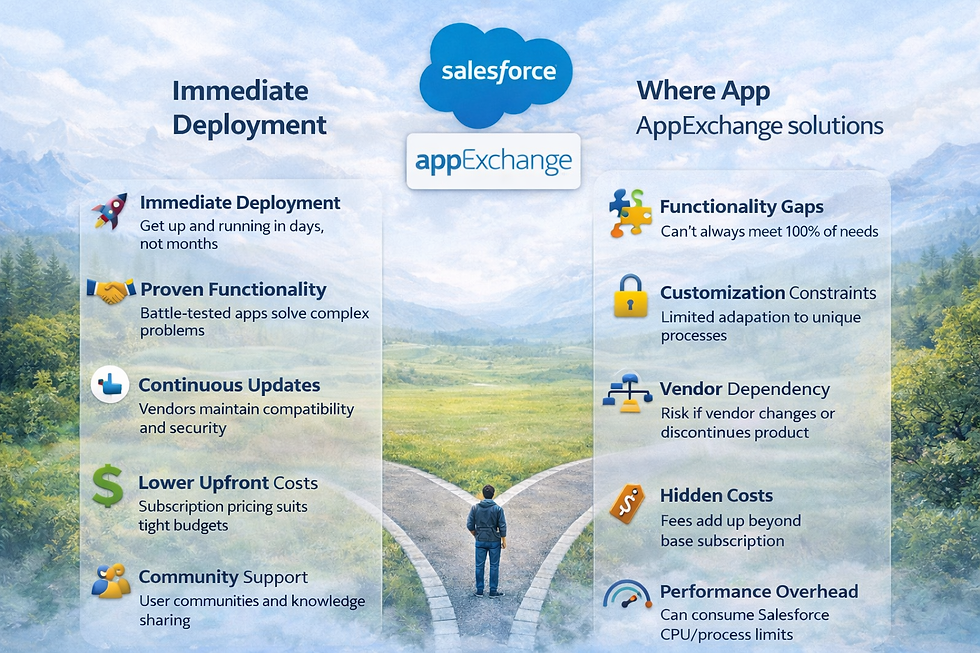
Where AppExchange Solutions Excel
Immediate deployment stands as AppExchange's most compelling advantage. Install a solution today, configure it tomorrow, go live next week. For nonprofits with urgent needs—think launching a year-end campaign or responding to emergency fundraising requirements—this speed can be mission-critical.
Proven functionality means someone else has already solved the hard problems. Reputable AppExchange vendors have invested thousands of development hours handling edge cases, security vulnerabilities, and performance optimization. You're buying battle-tested solutions rather than starting from scratch.
Continuous updates ensure compatibility with Salesforce's three annual releases. When Salesforce changes API versions or introduces new security requirements, AppExchange vendors update their solutions. This maintenance burden disappears from your technology team's responsibility list.
Lower upfront costs make AppExchange attractive for budget-constrained nonprofits. Most solutions operate on subscription models ranging from $500 to $5,000 annually, compared to custom development projects starting at $15,000 and often exceeding $50,000.
Community support provides access to user groups, documentation libraries, and peer networks. When you encounter configuration challenges, you're tapping into collective wisdom rather than figuring everything out independently.
Where AppExchange Solutions Fall Short
Functionality gaps represent the most common frustration. An AppExchange solution might handle 80% of your requirements brilliantly, but that missing 20% forces uncomfortable workarounds. A scholarship management app might track applications perfectly but lack the specific compliance reporting your state education department requires.
Customization constraints limit how much you can adapt solutions to your processes. AppExchange apps are built for broad markets, not your specific operational model. You might need to change your workflows to match the software rather than the reverse.
Vendor dependency creates risk. If an AppExchange vendor goes out of business, gets acquired, or pivots their product strategy, you're along for the ride. We've seen nonprofit organizations forced into emergency migrations when vendors discontinued products with six months' notice.
Hidden costs accumulate beyond base subscriptions. Premium features often carry additional fees. User-based pricing can escalate as your organization grows. Integration between multiple AppExchange solutions sometimes requires yet another integration tool.
Performance overhead can impact system responsiveness. Each AppExchange package consumes Salesforce governor limits (API calls, storage, processing time). Install too many solutions and you may hit platform constraints, especially during high-traffic periods like year-end fundraising campaigns.
The Custom Development Case: When to Build
Custom API development makes strategic sense in specific scenarios. Understanding these situations helps nonprofits invest development resources where they deliver maximum value rather than recreating capabilities available off-the-shelf.
Compelling Use Cases for Custom Development
Unique competitive differentiators justify custom builds when your organization's approach creates a genuine mission advantage. A youth development nonprofit built a custom API integrating Salesforce with their proprietary curriculum tracking system, an integration that became central to their fundraising story, demonstrating measurable impact in ways that drove major gift commitments. Off-the-shelf solutions couldn't capture their unique program model.
Complex compliance requirements often demand custom solutions. Healthcare-focused nonprofits managing HIPAA-compliant patient data, international organizations navigating GDPR requirements, or research institutions handling sensitive participant information may find AppExchange solutions lack the necessary controls. Custom development allows precise implementation of compliance frameworks.
Legacy system integrations frequently require custom APIs. A university foundation needed to integrate Salesforce with a 30-year-old mainframe advancement system containing decades of alumni giving data. No AppExchange solution understood the mainframe's data formats or business logic. Custom API development created the bridge, preserving institutional knowledge while modernizing constituent engagement.
Process automation at scale sometimes exceeds AppExchange capabilities. An international relief organization processes 50,000 monthly donations across 15 currencies, each requiring specific tax receipts, currency conversion tracking, and regulatory reporting. Their custom API orchestrates this complexity with precision that generic donation processing tools can't match.
Strategic data ownership matters when integration logic itself contains valuable intellectual property. A nonprofit consortium built custom APIs to share program outcome data across member organizations while maintaining precise privacy controls. This data-sharing infrastructure became a competitive recruitment advantage for attracting new members.
Real Cost Analysis: Beyond Initial Development
Custom API development costs extend beyond initial builds. A realistic budget includes development (initial build: $15,000-$50,000 for typical nonprofit integrations, complex projects: $75,000-$150,000+), infrastructure (hosting, monitoring tools, security: $1,200-$3,600 annually), maintenance (bug fixes, API version updates: $3,000-$8,000 annually, typically 15-20% of development cost), enhancements (new features, expanded functionality: $5,000-$15,000 annually), and documentation (technical specs, user guides: often overlooked but critical).
The three-year total cost of ownership for a $30,000 custom API typically reaches $55,000-$75,000 when accounting for all factors. Compare this against AppExchange alternatives charging $2,000-$4,000 annually ($6,000-$12,000 over three years) and the financial case demands clear justification.
Strategic Decision Framework: Choosing Your Path

Making the build-versus-buy decision requires systematic evaluation across multiple dimensions. We've developed the following framework that helps nonprofit technology leaders navigate this choice strategically rather than reactively.
Step 1: Functionality Gap Assessment
Start by documenting the exact requirements. Be specific—"integrate with donation platform" is too vague. Instead: "Sync donation records to Salesforce within 5 minutes of transaction completion, including custom fields for tribute gifts and matching gift eligibility, while maintaining donor communication preferences across both systems."
Evaluate AppExchange solutions against these requirements using an 80/20 threshold. If available solutions meet 80% of needs, serious consideration is warranted. The remaining 20% might be addressed through configuration, workarounds, or process adjustments. Below 80% match, custom development becomes more defensible.
Test before committing. Most AppExchange vendors offer trial periods or sandbox installations. Actually use the software with real scenarios before making financial commitments. This hands-on evaluation reveals limitations that product demonstrations artfully avoid.
Step 2: Total Cost of Ownership Comparison
Calculate three-year costs for both options. AppExchange TCO includes base subscription, additional user licenses, premium feature costs, integration tools, implementation consulting, and staff training time. Custom development TCO includes initial development, ongoing maintenance, infrastructure, enhancement budget, internal staff time (project management, testing, stakeholder coordination), and knowledge transfer/documentation.
Factor in opportunity costs. Custom development ties up technical resources that could address other organizational priorities. If your development team is already backlogged, adding a four-month API project delays other initiatives. AppExchange solutions free technical capacity for higher-value work.
Step 3: Timeline and Urgency Assessment
Timeline requirements often determine the decision. Launching a campaign in six weeks? AppExchange is likely your only viable option. Planning system improvements for next fiscal year? Custom development timelines become feasible.
Consider phased approaches. Sometimes the optimal strategy combines both: deploy an AppExchange solution immediately to address urgent needs, then build custom APIs incrementally to handle unique requirements. This pragmatic middle path maintains momentum while planning for long-term optimization.
Step 4: Internal Capability Assessment
Honestly evaluate your team's technical capacity. Custom API development requires developers with Salesforce expertise, not just general programming skills. Do you have staff who understand Salesforce governor limits, API versioning, and security models? Can you maintain custom code if the original developer leaves?
AppExchange solutions demand less technical depth but still require configuration expertise and ongoing administration. Lighter technical requirements doesn't mean zero technical requirements.
The Hybrid Approach: Best of Both Worlds

Most successful nonprofit technology strategies don't choose exclusively between custom development and AppExchange—they strategically combine both. The most effective implementations use AppExchange for commodity functions (donor management, email marketing, event registration, basic reporting, payment processing) and custom APIs for differentiating capabilities (unique program workflows, proprietary impact measurement, specialized compliance reporting, competitive integration requirements, strategic data partnerships).
Real-World Hybrid Success Stories
A regional food bank uses AppExchange solutions for donor management (Nonprofit Cloud), email marketing (Marketing Cloud Account Engagement), and volunteer scheduling (off-the-shelf volunteer management app). They built custom APIs for integrating with their warehouse inventory system and creating real-time donation impact dashboards showing exactly how each dollar translates to meals distributed. The custom work handles their unique operational model; AppExchange covers standard nonprofit functions.
An environmental conservation organization leverages AppExchange for grants management and program tracking. Their custom API development focuses on integrating field research data collection tools with Salesforce, enabling real-time visualization of conservation outcomes tied to specific funding sources. This custom integration became central to their major donor cultivation strategy, demonstrating direct impact in ways that generic solutions couldn't capture.
Implementation Best Practices: Setting Projects Up for Success
Regardless of whether you choose custom development, AppExchange solutions, or a hybrid approach, certain practices dramatically improve implementation success rates.
Custom API Development Best Practices
Start with a minimum viable product (MVP). Build core functionality first, validate with users, then expand. This iterative approach catches requirement misunderstandings early when they're cheaper to fix. A scholarship management API might launch with basic application tracking before adding complex eligibility rules and automated award calculations.
Invest heavily in documentation. Future developers (including yourself in six months) will thank you. Document not just what the code does but why specific approaches were chosen. Architecture decisions that seem obvious today become mysterious months later.
Build for Salesforce's future, not just present. Salesforce releases three major updates annually. Use current API versions, follow Salesforce coding best practices, and avoid deprecated features. Code built to outdated standards becomes technical debt rapidly.
Implement comprehensive error handling and logging. APIs fail in production—network issues, data quality problems, edge cases. Robust error handling and detailed logging make troubleshooting manageable rather than maddening.
Plan for authentication and security from day one. Don't treat security as an afterthought. Implement OAuth 2.0, use named credentials, and follow the principle of least privilege. Security retrofits are expensive and risky.
AppExchange Implementation Best Practices
Thoroughly vet vendors before commitment. Check customer references, review support responsiveness, and examine update frequency. A vendor's track record predicts future reliability better than marketing materials.
Test in sandbox environments first. Never install AppExchange solutions directly into production. Sandbox testing reveals conflicts with existing customizations and identifies configuration challenges before they impact live operations.
Understand the data model completely. How does the AppExchange solution store data? Where do records live? What happens during uninstallation? These questions matter for long-term data integrity and future flexibility.
Plan for vendor transitions. What's your contingency if the vendor disappears or radically changes their product? Understanding exit strategies before commitment provides essential risk mitigation.
Monitor governor limit consumption. AppExchange apps use your organization's Salesforce limits. Track API calls, storage usage, and processing time to avoid hitting platform constraints during critical periods.
Common Pitfalls to Avoid
We've seen nonprofit technology projects stumble on predictable challenges. Awareness helps you avoid these common traps.
Custom Development
Underestimating maintenance burden. The initial build is just the beginning. Custom APIs require ongoing attention—security patches, Salesforce version updates, and feature enhancements. Organizations that budget only for development without maintenance capacity end up with technical debt.
Building for perfection instead of iteration. Trying to anticipate every future requirement leads to overengineered solutions that take forever to ship. Better to launch functional MVPs and evolve based on actual usage patterns.
Insufficient stakeholder involvement. Custom development fails when built in isolation from actual users. Regular feedback loops throughout development catch misalignments before they become expensive problems.
Key person dependency. If only one person understands your custom APIs, you've created organizational risk. Cross-training, documentation, and code reviews distribute knowledge across teams.
AppExchange Selection
Choosing based on initial cost alone. The cheapest solution often becomes expensive through hidden costs, limited functionality, or poor support. Evaluate total value, not just subscription fees.
Installing too many point solutions. Each AppExchange app adds complexity. Five specialized solutions might individually make sense but collectively create integration nightmares and platform performance issues.
Ignoring user adoption challenges. The best AppExchange solution fails if staff won't use it. Consider user experience, training requirements, and change management alongside technical capabilities.
Overlooking data ownership questions. What happens to your data if you stop using the solution? Can you export everything? In what format? These questions matter for long-term organizational autonomy.
Making the Decision: Your Action Plan
Ready to decide between custom API development and AppExchange solutions? Follow this systematic process to reach a strategic decision rather than a reactive one.
Step-by-Step Evaluation Checklist
Document precise requirements in detail with specific data flows, timing requirements, security needs, compliance obligations, and user experience expectations.
Research AppExchange options thoroughly through trial installations in sandbox, user reference checks, vendor financial stability assessment, support quality evaluation, and update frequency verification.
Calculate three-year TCO for both paths, including all direct costs, internal staff time, opportunity costs, and risk mitigation expenses.
Assess internal capabilities honestly, evaluating current technical skills, available capacity, knowledge retention risk, and long-term maintenance ability.
Evaluate strategic importance to determine if this capability differentiates your mission, provides a competitive advantage, or contains proprietary value.
Consider hybrid approaches that combine AppExchange for standard functions with custom development for unique requirements.
Make the decision with stakeholder input, documented rationale, and clear success metrics.
Choose Custom Development When:
No AppExchange solution meets 80% of the requirements
Integration requirements are highly specific to unique systems
Capability represents a competitive differentiator for your mission
Compliance requirements demand precise controls
Long-term total cost justifies the upfront investment
The internal team has the capacity and expertise for ongoing maintenance
Choose AppExchange When:
Available solutions address 80%+ of needs
Timeline requires immediate implementation
Functionality represents commodity (common to many nonprofits)
Internal technical capacity is limited
Ongoing vendor maintenance provides value
Total cost of ownership favors the subscription model
Partner with Ohana Focus

The choice between custom API development and AppExchange solutions shapes your nonprofit's technology trajectory for years. Making this decision strategically—with a clear understanding of costs, capabilities, and long-term implications—separates technology investments that transform mission impact from those that become expensive burdens.
Ohana Focus helps nonprofits navigate these complex technology decisions with practical, mission-focused guidance. As certified Salesforce consulting partners specializing in nonprofit technology strategy, we bring deep expertise in both custom API development and AppExchange solutions. Our Strategic Technology Assessment services include:
Comprehensive requirements analysis that uncovers actual needs beyond initial requests
AppExchange solution evaluation with vendor vetting and trial coordination
Custom development feasibility assessment, including realistic cost and timeline projections
Total cost of ownership modeling for informed financial decision-making
Hybrid strategy development that optimally combines both approaches
Implementation roadmaps with phased approaches that maintain operational continuity
Ongoing architecture guidance as your technology needs evolve
We've guided dozens of nonprofits through build-versus-buy decisions, helping organizations avoid expensive missteps while implementing technology that genuinely advances mission outcomes. Our approach combines technical expertise with an understanding of nonprofit operational realities and budget constraints. We'll help you evaluate your specific situation and develop a clear path forward—whether that's custom development, AppExchange solutions, or a strategic combination of both.
About Ohana Focus
Ohana Focus is a certified Salesforce consulting partner specializing in nonprofit technology strategy, custom development, and integration architecture. We help nonprofit organizations bridge the gap between technology possibilities and mission realities, implementing solutions that deliver measurable impact without unnecessary complexity or cost.


Comments